
Last updated July 10, 2026
Air Duct Cleaning Maintenance Checklist for New York City Homeowners
If your neighbor on the 4th floor just finished a gut renovation, your duct system absorbed a significant share of that debris regardless of whether anyone opened a window — and no standard maintenance schedule accounts for that. In New York City, where buildings share walls, shafts, and mechanical systems, duct contamination doesn’t follow a suburban playbook of seasonal filter swaps and biennial cleanings. Over 11 years running Empire Air Duct Cleaning Service New York, we’ve found that NYC homeowners who track building-specific triggers — renovation permits, humidity spikes, and co-op board maintenance cycles — catch problems 6 to 18 months before generic checklists would flag them. This guide gives you that location-aware framework.
Quick Answer
New York City homeowners should inspect visible registers monthly, replace filters every 60 to 90 days (adjusted for AQI readings), schedule professional duct cleaning every 3 to 5 years for standard residences, and immediately after neighboring renovations or water damage events. The checklist below is organized by frequency — daily awareness, monthly inspection, seasonal action, and event-triggered response — with NYC-specific triggers that generic guides miss.
Table of Contents
- Monthly Visual Inspection: What Your Registers Tell You
- Filter Replacement Logging: Building Your Personal Interval
- Seasonal Humidity Checkpoints: NYC’s Mold Precursor
- Neighbor Renovation Alerts: Tracking Permit Activity
- Building-Type Variations: Co-op, Condo, and Rental Responsibilities
- Professional Cleaning Intervals and What to Request
- Common Mistakes to Avoid
- When to Call a Professional
- Frequently Asked Questions
Monthly Visual Inspection: What Your Registers Tell You
Most New York City apartments and townhouses have supply registers and return vents that tell a story if you know what to look for. We train our customers to do a 5-minute walk-through once a month — not because it replaces professional cleaning, but because early visual cues prevent small problems from becoming full contamination events.
Here’s what to check and what specific colors and textures mean:
- Black, sooty buildup on register fins: This typically indicates combustion byproduct infiltration — common in pre-war buildings with aging boiler systems or in units near busy avenues where vehicle exhaust penetrates the building envelope. In Manhattan, we see this concentrated on lower floors of buildings facing FDR Drive or the West Side Highway.
- Gray, fibrous matting: Usually degraded flex duct liner or deteriorating insulation from the duct itself. This is a material failure signal, not just dirt. In New York City’s humidity swings, adhesive backing on older duct liner fails faster than in drier climates.
- Sticky, yellow-brown film: Often cooking grease that has migrated through the system — especially common in open-plan layouts or buildings where kitchen exhaust ducts are undersized or shared. We’ve pulled pounds of polymerized grease from SoHo and Tribeca lofts where high-end ranges vent into inadequate shared shafts.
- White, powdery residue: Frequently efflorescence or concrete dust from ongoing construction, or in worst cases, early mold sporulation. In new construction or recently renovated buildings in Hudson Yards or the Financial District, this is almost always construction debris, not biological growth.
- Uniform gray dust with no distinct texture: Normal accumulation. If it’s evenly distributed and wipes away with a damp cloth, you’re within expected parameters for an urban environment.
Document what you find with phone photos dated in a notes app. When you call for service, these images let us diagnose whether you’re looking at a cleaning issue, a duct repair problem, or an HVAC system imbalance that needs addressing.
Filter Replacement Logging: Building Your Personal Interval
The “change every 90 days” rule fails in New York City because outdoor air quality varies dramatically by season, by avenue, and by what’s happening in your specific block. A Park Slope homeowner facing Prospect Park gets different particulate loads than an identical unit on Canal Street.
We recommend building a personal replacement interval using this method:
- Baseline: Install a new filter and note the date. Use a MERV 8 to 11 pleated filter — sufficient for urban particulate without overloading residential blower motors.
- Track concurrent AQI: Log the EPA Air Quality Index for your ZIP code weekly. In New York City, AQI spikes during summer ozone events (typically July through August) and winter inversion periods (December through February). When AQI exceeds 100 for three consecutive days, your filter is working at 2 to 3x normal load.
- Visual inspection at 30, 60, and 90 days: Hold the filter to window light. If you can’t see distinct pleat gaps, it’s loaded regardless of elapsed time.
- Adjust your interval: If you’re replacing at 45 days consistently, your personal interval is 45 days — not the manufacturer’s 90. Document this. It becomes evidence if you ever need to demonstrate maintenance diligence to a co-op board or insurance adjuster.
In our experience across New York City, Upper East Side and Upper West Side buildings with park exposure average 75-day intervals. Midtown and Downtown units with construction density and traffic canyon effects often need 50 to 60-day cycles. The only way to know your number is to log it.
Seasonal Humidity Checkpoints: NYC’s Mold Precursor
New York City’s humidity profile is more extreme than most homeowners recognize. Summer dew points regularly hit 70°F, and the shoulder seasons — April and October — bring rapid swings that create condensation inside ductwork before HVAC systems have switched modes.
Spring condensation is the single most underdiagnosed mold precursor we encounter. In March and April, outdoor humidity rises while heating systems still run. Warm, moist air hits cool duct surfaces and condenses. By May, we’re receiving calls from Brooklyn Heights to the Lower East Side with musty odors that started six weeks earlier as invisible moisture accumulation.
Your seasonal checklist:
| Season | Action | NYC-Specific Trigger |
|---|---|---|
| March–April | Run bathroom and kitchen exhaust fans 30 minutes after cooking/showering; inspect accessible duct joints for moisture staining | Spring humidity spike before AC activation; buildings with delayed seasonal HVAC switchovers are highest risk |
| May–June | Schedule pre-summer professional inspection if you detected spring moisture; verify condensate drain lines are clear | First sustained heat waves stress systems that sat idle; post-winter startup failures peak this window |
| July–August | Monitor for musty odors when AC first cycles each day; check filter loading more frequently | Ozone and particulate peaks; filters load faster; overloaded filters reduce airflow and increase coil condensation |
| September–October | Pre-heating inspection of humidifier components; check for summer mold growth in rarely-used rooms | Rapid humidity drop can crack dried biological material, releasing spores; inverted pressure dynamics as systems switch to heating |
| November–February | Verify fresh air intake dampers close properly; inspect for ice formation on exterior duct runs in older buildings | Winter inversion traps pollutants; steam heating systems in pre-war buildings create localized humidity pockets |
If you smell mustiness when your system first activates each day, that’s not normal “settling.” It’s active microbial growth being disturbed by airflow. Address it before it becomes visible.
Neighbor Renovation Alerts: Tracking Permit Activity
In New York City’s dense housing stock, your ducts don’t end at your walls. Shared mechanical shafts, party walls with gaps at firestopping, and positive-pressure construction environments in adjacent units create migration pathways that standard maintenance ignores.
When a neighboring unit undergoes gut renovation, contractors create significant positive pressure with dust-generating activities — drywall sanding, tile cutting, floor refinishing. That pressure seeks exit paths, and your duct registers are low-resistance openings. We’ve extracted concrete dust, silica, and wood particulate from systems where the homeowner never opened a window during the neighbor’s project.
Here’s how to track and respond:
- Monitor DOB permits: The New York City Department of Buildings publishes permit data online. Search your building’s BIN (Building Identification Number) monthly. Alteration Type 2 permits indicate interior renovations that generate significant dust loads.
- Talk to your super or managing agent: In co-op and condo buildings, renovation applications typically require board approval. Ask when major projects are scheduled, especially on floors directly above or below you, or units sharing your HVAC zone.
- Seal registers during active construction: If you know heavy demo or sanding is occurring, cover supply and return registers with painter’s tape and plastic sheeting during work hours. Remove covering and run your system on “fan only” for 30 minutes after construction ends to flush any migrated particulate.
- Schedule inspection within 30 days of project completion: Even with precautions, some infiltration occurs. A professional camera inspection identifies whether cleaning is warranted or if sealing is needed at shared wall penetrations.
In Gramercy Park and similar historic districts where buildings share common structural elements, we’ve seen cross-unit contamination from renovations three floors away. The density creates connectivity that single-family homeowners never face.
Building-Type Variations: Co-op, Condo, and Rental Responsibilities
Who owns your ducts determines who pays for maintenance — and who you need to coordinate with. New York City’s housing stock spans ownership structures with sharply different maintenance obligations.
Co-operative Apartments (Co-ops)
In co-ops, the corporation owns the building, including common mechanical systems. Your proprietary lease defines where your responsibility begins. Typically:
- Building responsibility: Main risers, shared return plenums, and central equipment (fans, coils, humidifiers)
- Shareholder responsibility: Branch ducts serving your unit exclusively, and all registers/grilles
The catch: most co-op boards schedule riser cleaning on 5 to 10-year cycles, but your branch ducts may need attention sooner. We’ve cleaned shareholder-owned branch lines in buildings where the main risers were pristine — the contamination was localized to the unit’s exclusive ductwork. Document your requests to the board in writing; if they decline accelerated riser cleaning, you can still protect your unit’s branch lines independently.
Condominiums
Condos operate under a declaration and bylaws system. The “limited common element” designation is critical — ducts serving only your unit but running through common walls may be your financial responsibility even though you don’t own the physical space they occupy.
Review your offering plan or ask your managing agent for the mechanical systems allocation table. In newer Manhattan condos, developers often designate all ductwork as limited common elements, making unit owners responsible for maintenance. In older conversions, original systems may remain common elements. There’s no standard — you must verify your specific building.
Rentals
Landlords are required to provide heat and hot water, but duct cleaning falls outside warranty of habitability unless contamination causes documented health impacts. For market-rate rentals, negotiate cleaning into your lease renewal if you have respiratory sensitivities. For rent-stabilized units, document all requests and responses; if you pay for cleaning yourself, you may have recourse through DHCR for reimbursement if you can demonstrate the service was necessary due to landlord neglect of common systems.
In all three housing types, the Empire Air Duct Cleaning Service New York team has worked directly with supers, managing agents, and board members to coordinate access and define scope. We know the documentation standards that satisfy New York City building management.
Professional Cleaning Intervals and What to Request
Even diligent DIY maintenance doesn’t replace mechanical agitation and negative-pressure extraction. Here’s how to think about professional service intervals in New York City conditions:
| Residence Profile | Recommended Interval | Trigger for Acceleration |
|---|---|---|
| Standard residential, no smokers, no pets, no recent renovations | 4 to 5 years | Visible debris at registers, musty odors, increased allergy symptoms |
| With pets (shedding breeds) | 3 years | Visible hair accumulation in return grilles, reduced airflow at distant registers |
| Post-renovation (your unit or adjacent) | Within 6 months of project completion | Any visible dust surge during construction, new odors when system cycles |
| Pre-war building with original ductwork | 2 to 3 years with camera inspection | Evidence of deteriorating liner, asbestos-containing materials, or galvanized steel corrosion |
| After water damage or leak event | Immediate inspection; cleaning if moisture reached ducts | Any water staining near registers, mustiness within 48 hours of event |
When you hire, request specifics that separate professional work from surface cleaning:
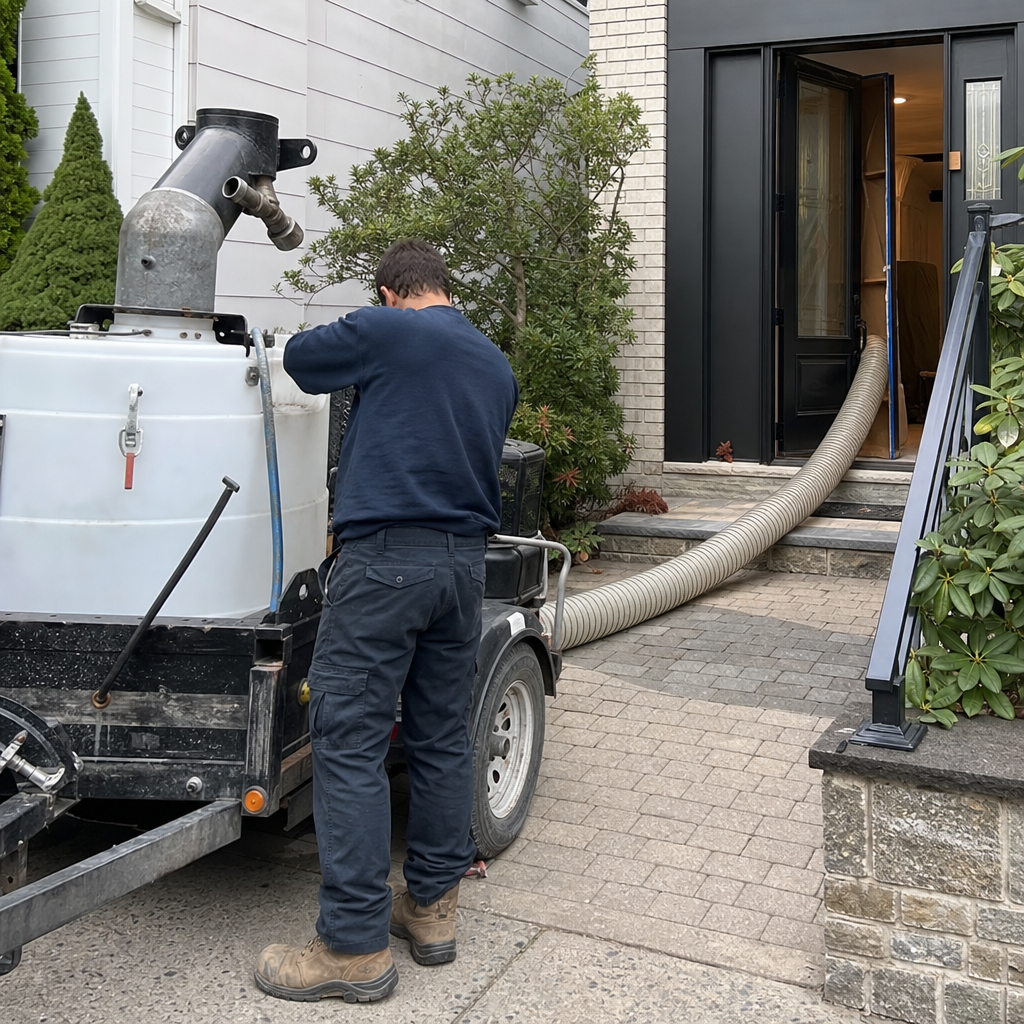
- Rotary brush contact cleaning: The brush system must physically contact duct walls to dislodge adhered debris. We use Rotobrush systems for this mechanical agitation — shop vacuums with no contact mechanism simply move surface dust.
- Negative-pressure containment: The vacuum collection unit should create suction that prevents debris from escaping into your living space during cleaning. Our Nikro systems maintain this containment throughout the process.
- Before/after documentation: Camera inspection footage of representative duct sections. Any provider refusing this is selling you an invisible service.
- Sanitizing as separate decision: EPA-registered sanitizers (we use products compatible with Honeywell, Aprilaire, and Abatement Technologies application standards) should be offered as an add-on, not bundled as default. They’re appropriate after mold events or for immunocompromised occupants, not for routine maintenance.
Steven runs the job himself on every Empire Air Duct Cleaning Service New York project — you’ll speak with the same person who operates the equipment and makes real-time decisions about your system’s condition.
Common Mistakes to Avoid
- Using the cheapest filter that fits: Fiberglass panel filters capture less than 20% of urban particulate. In New York City’s particle-dense environment, they load in weeks and bypass debris into your ductwork. Spend the extra $4 per filter for pleated construction.
- Ignoring return vents: Homeowners clean supply registers because they’re visible and accessible. Return vents — often behind furniture or in utility closets — collect more debris because they draw unfiltered room air continuously. Include them in your monthly inspection.
- Sealing registers permanently for “efficiency”: We’ve found apartments where owners taped over unused bedroom registers to “force air elsewhere.” This creates pressure imbalances that strain blowers and can backdraft combustion appliances. If you have distribution problems, the solution is balancing dampers or duct modification, not register sealing.
- Assuming new construction means clean ducts: New York City new construction has some of the worst post-build contamination we encounter. Construction dust, drywall compound, and protective plastic fragments sit in ductwork for years if first occupants don’t demand pre-occupancy cleaning. We regularly clean systems in buildings delivered 2019 to 2023 that were never properly flushed.
- Treating “duct cleaning” and “HVAC cleaning” as identical: Duct cleaning addresses distribution pathways. HVAC cleaning includes coils, blowers, and drain pans — the components that condition air. A clean duct system with fouled coils recirculates contamination immediately. For comprehensive service, we offer both as coordinated scope.
- Waiting for visible mold to act: By the time mold is visible at registers, colonization is extensive inside the duct. The musty-odor-first rule applies: smell is your earliest reliable indicator.
When to Call a Professional
Call for inspection — not necessarily full service — when you detect musty odors, visible moisture, airflow reduction at distant registers, or debris that returns within weeks of surface cleaning. In New York City’s building density, these symptoms rarely resolve without mechanical intervention.
Empire Air Duct Cleaning Service New York offers free estimates throughout New York City. Steven Ramirez personally assesses each project, and we use Rotobrush and Nikro systems with documentation standards that satisfy co-op boards and insurance adjusters. Nearly 1,000 customers reviewed us — 982 verified reviews averaging 4.9 stars — because we show up, do the work thoroughly, and explain what we found in plain language. Call (877) 542-5983 to schedule.
Frequently Asked Questions
Residential duct cleaning in New York City typically ranges from $400 to $900 for standard apartments and townhouses, with larger units or buildings with complex duct layouts reaching $1,200 to $1,800. The variation depends on duct accessibility, contamination severity, and whether HVAC components require concurrent service. Call (877) 542-5983 for a free, no-obligation estimate based on your specific layout — we price after inspection, not before.
New York City homeowners should clean ducts every 3 to 4 years on average — roughly 20% more frequently than suburban counterparts — due to higher ambient particulate, shared building systems, and renovation density from adjacent units. The urban environment creates contamination pathways that single-family homes simply don’t experience. Your personal interval should shorten further if you live near active construction, major avenues, or in pre-war buildings with original ductwork.
Homeowners can and should perform monthly register wiping, filter replacement, and visual inspection, but mechanical duct cleaning requires equipment that creates both contact agitation and negative-pressure containment — tools that cost more than professional service for a one-time use. In New York City’s multi-unit buildings, DIY attempts without proper containment risk distributing debris into neighboring units, creating liability exposure. For anything beyond surface maintenance, hire a provider who carries appropriate coverage and documents their work.
Shared duct problems show as building-wide symptoms: similar odors on multiple floors, simultaneous allergy complaints from neighbors, or debris patterns that match across units regardless of individual housekeeping. If your register contamination returns within weeks of cleaning and matches what neighbors describe, the source is likely upstream in common risers. Document and present this pattern to your board or managing agent — we provide inspection reports that support these requests with camera evidence.
Properly performed duct cleaning measurably reduces airborne particulate and bioaerosol loads — but “properly performed” is the critical qualifier. The scam reputation comes from low-price operators who vacuum registers without mechanical contact inside ducts, leaving 80% of contamination in place. Legitimate service uses rotary brush contact (we use Rotobrush systems) with simultaneous negative-pressure extraction (Nikro), plus before/after documentation. Our 982 verified reviews reflect consistent execution of this standard, not bait-and-switch pricing.
If your dryer shares a wall or mechanical chase with your HVAC ductwork, or if both systems haven’t been serviced in the same interval, coordinating cleaning is efficient and often reveals related airflow problems. Dryer lint accumulation creates fire risk and reduces exhaust efficiency, forcing dryers to run longer and increasing humidity loads that stress HVAC systems. Empire Air Duct Cleaning Service New York handles both as integrated scope — one call covers it all, with Steven assessing both systems during the same site visit.
The Bottom Line
New York City duct maintenance succeeds when it’s responsive to urban-specific triggers — neighbor renovations, humidity swings, shared building systems, and particulate loads that suburban checklists don’t address. The framework here replaces generic calendar reminders with observation-based action: monthly register inspection, AQI-adjusted filter logging, seasonal humidity monitoring, permit tracking, and building-type-aware responsibility mapping. Professional cleaning with documented, equipment-based methods fills the gaps that homeowner maintenance cannot reach. With 11 years of one specialty and nearly 1,000 verified customer reviews, we’ve built our practice on recognizing what makes New York City’s indoor air challenges unique — and solving them thoroughly.
Written by Steven Ramirez, Owner & Lead Technician at Empire Air Duct Cleaning Service New York, serving New York City since 2015.