
Last updated July 10, 2026
Air Duct Cleaning Permits, Codes & Inspections in NY: What You Need to Know
Most New York City homeowners assume air duct cleaning is straightforward maintenance — no permits, no inspections, no paperwork. For a basic mechanical cleaning with brushes and vacuum, that’s usually correct. But here’s what changes everything: the moment a contractor sprays an EPA-registered antimicrobial inside your ducts, applies a chemical sealant, or discovers mold and begins remediation work, you’ve crossed into regulated territory under New York State DEC rules and NYC Local Law 61. We’ve seen building managers in Manhattan co-ops blindsided when a routine cleaning triggered a Department of Buildings inquiry because the contractor used a sanitizer without proper documentation. In this guide, we’ll walk you through exactly where the line falls between unregulated cleaning and code-triggering work, what permits and disclosures apply, and how to protect yourself as a property owner in New York City’s complex regulatory environment.
Quick Answer
Standard air duct cleaning — mechanical brushing and vacuuming — does not require a permit in New York State or New York City. However, antimicrobial application, mold remediation, or any physical modification to ductwork triggers specific regulatory requirements: NYC Local Law 61 for mold assessment and remediation, NY State DEC notification for certain chemical applications, and potential DOB permits for mechanical alterations. Co-op and condo buildings often impose additional alteration agreement requirements regardless of permit status.
Table of Contents
- Where the Line Falls: Cleaning vs. Regulated Work
- NYC Local Law 61 and Mold Remediation Thresholds
- Antimicrobials, Sealants, and Disclosure Requirements
- When Ductwork Modification Needs a DOB Permit
- Co-op and Condo Alteration Agreements
- Documentation to Retain After Your Cleaning
- Common Mistakes to Avoid
- When to Call a Professional
- Frequently Asked Questions
- The Bottom Line
Where the Line Falls: Cleaning vs. Regulated Work
After 11 years running Empire Air Duct Cleaning Service New York home, we’ve learned that the most expensive mistake a homeowner makes isn’t hiring the wrong company — it’s not knowing what questions to ask about where their job sits on the regulatory spectrum.
Here’s the breakdown that matters:
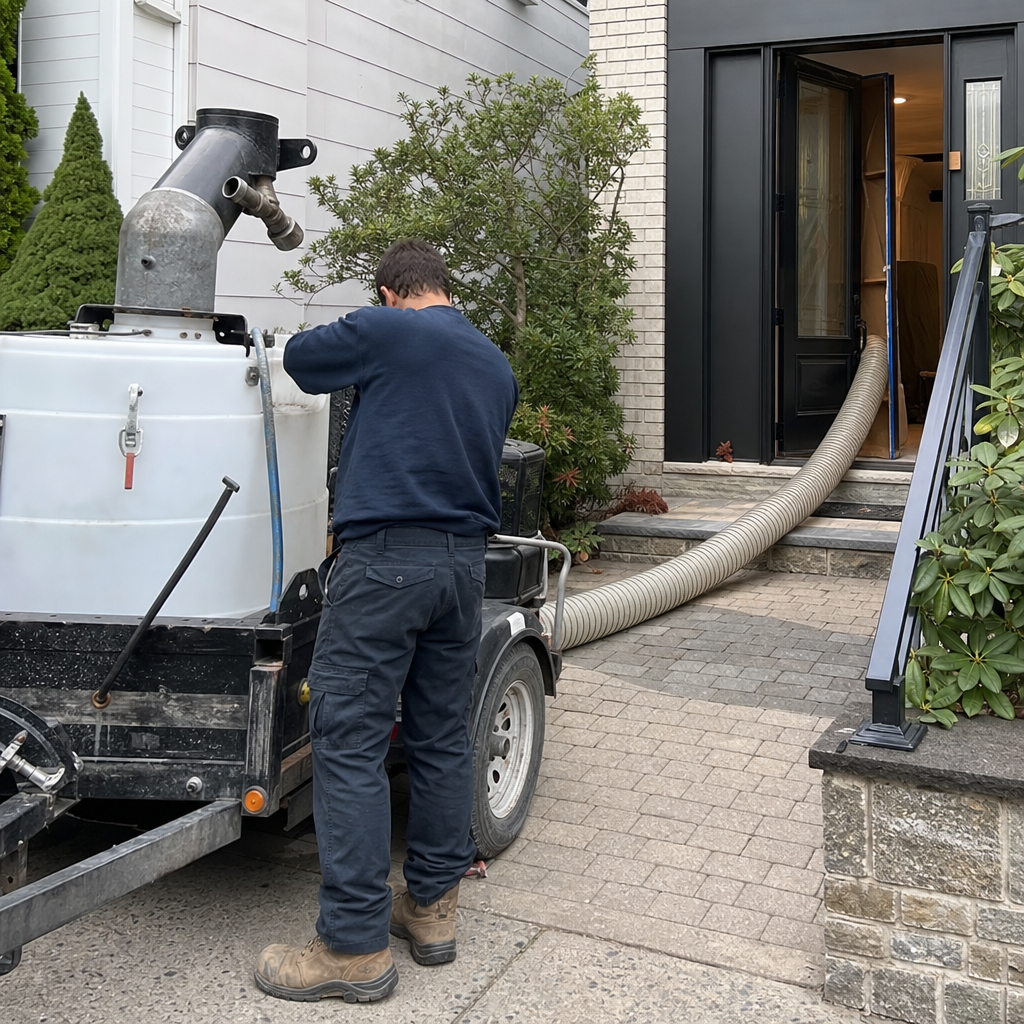
Unregulated cleaning (no permits, no special disclosures): Mechanical agitation with rotary brushes — we use Rotobrush systems — combined with negative-air vacuum extraction. This is what most homeowners need every 3-5 years in New York City’s dusty, pollen-heavy climate, especially in neighborhoods near construction zones like Hudson Yards or the ongoing development around Gowanus.
Regulated work (permits, disclosures, or certified personnel required):
- Application of any EPA-registered antimicrobial, disinfectant, or sanitizer inside ductwork
- Mold remediation exceeding 10 square feet or involving HVAC systems (NYC Local Law 61)
- Physical modification, extension, or rerouting of ductwork
- Installation of new duct sections or access panels that alter the building’s mechanical plan
- Work in buildings with asbestos-containing duct insulation (common in pre-1980s New York City housing stock)
The climate factor matters here. New York City’s humidity swings — from summer saturation to winter dry heating — create condensation inside duct systems, particularly in unconditioned spaces of brownstones and pre-war buildings. That moisture can trigger mold growth that a homeowner doesn’t discover until a cleaning is underway. A contractor who doesn’t understand the regulatory threshold might start remediation work without the proper assessment protocol, exposing both parties to liability.
We’ve encountered this exact scenario in Gramercy Park pre-war buildings where decades of layered paint and plaster dust combined with humidity created conditions that looked like simple debris but tested positive for active mold. The difference between a $400 cleaning and a $2,800 mold remediation project isn’t just price — it’s whether the work requires a NYC Department of Environmental Protection notification and a post-remediation inspection by a licensed mold assessor.
NYC Local Law 61 and Mold Remediation Thresholds
NYC Local Law 61 of 2014, implemented fully by 2016, created the most significant regulatory framework for duct-related work in New York City. The law mandates specific procedures for mold assessment and remediation in buildings, and it explicitly includes HVAC systems and ductwork in its scope.
The critical threshold: Any mold contamination affecting more than 10 square feet in a single area, or any mold inside an HVAC system regardless of visible size, requires a licensed mold assessor to evaluate the condition before remediation begins. The assessor cannot be affiliated with the remediation company — this separation is mandatory and non-negotiable.
Here’s what the process looks like when your duct cleaning crosses this line:
- Stop work and contain the area. A contractor who discovers active mold during cleaning must halt mechanical agitation, which can spread spores, and establish containment.
- Engage a licensed mold assessor. This independent professional evaluates the extent, documents conditions with photography, and develops a remediation plan.
- Remediation by a licensed mold remediation contractor. This may or may not be your original duct cleaning company — many, including generalist HVAC firms, do not hold this license.
- Post-remediation assessment. The original assessor returns to verify clearance, typically including air sampling.
- Documentation for building records. The complete file becomes part of your building’s compliance documentation.
The cost implications are substantial. A standard duct cleaning in a typical 1,200-square-foot New York City apartment runs $400-$700. Adding Local Law 61 compliance — assessor fees, containment, specialized remediation equipment from suppliers like Abatement Technologies, and post-clearance testing — typically pushes the total to $2,000-$4,500 depending on contamination extent and building access complexity.
We’ve seen unlicensed contractors in Queens and the Bronx attempt to “handle it quietly” by spraying antimicrobial and moving on. This isn’t just non-compliant — it’s a material misrepresentation that can void your homeowner’s insurance if mold-related damage appears later, and in co-op buildings, it can trigger board-imposed penalties or forced re-remediation at your expense.
Antimicrobials, Sealants, and Disclosure Requirements
This is where most New York City property owners get surprised — and where corner-cutting contractors create the most liability.
Applying an EPA-registered antimicrobial inside a duct system is not, legally speaking, “just cleaning.” Under New York State Department of Environmental Conservation regulations, these products carry specific use requirements that trigger disclosure obligations:
- Tenant notification: In rental buildings, application of certain antimicrobial products requires advance notice to occupants, typically 24-48 hours, with specified re-entry intervals
- Building management disclosure: Co-op, condo, and rental management must be informed of chemical applications in common mechanical systems
- Material Safety Data Sheet (SDS) retention: Records of exact products used, concentrations, and application locations must be maintained
- Application by certified personnel: Some products require applicator certification under FIFRA (Federal Insecticide, Fungicide, and Rodenticide Act)
The practical reality in New York City’s dense housing market: your ductwork connects to neighbors’ systems in many mid-rise and high-rise buildings. Chemical application in unit 4B can potentially affect air quality in 4A through 6B depending on building pressure differentials and shared return pathways. This interconnection is why building management disclosure isn’t bureaucratic overreach — it’s a genuine safety protocol.
We use Air Duct Cleaning in Gramercy Park as an example because this neighborhood’s 1960s-era co-op buildings frequently have shared plenum returns that make chemical application particularly sensitive. Before we apply any sanitizer — and we only do so when microbial testing justifies it — we verify building mechanical drawings and notify management in writing.
Chemical sealants present additional complexity. Products marketed as “duct lining” or “encapsulation” coatings that create a physical barrier inside ducts are sometimes classified as building materials rather than antimicrobials, but their application still frequently requires:
- Confirmation that the product meets NYC Building Code fire-resistance standards (typically ASTM E84)
- Documentation for insurance and warranty purposes
- In some buildings, filing with the Department of Buildings as an alteration
Our position after 11 years and nearly 1,000 customer reviews: if a contractor pushes chemical application as a standard part of every cleaning, that’s a red flag. Mechanical cleaning with professional Rotobrush and Nikro equipment, followed by targeted sanitizing only where testing indicates need, is the defensible approach that keeps you on the right side of disclosure requirements.
When Ductwork Modification Needs a DOB Permit
Standard cleaning doesn’t alter your ductwork. But repair, sealing, and modification work — which we regularly perform — sometimes crosses into Department of Buildings permit territory.
No permit required:
- Access panel installation for cleaning purposes (removable, non-structural)
- Sealant application to existing joints and seams (mastic, foil tape)
- Internal cleaning of existing components
- Filter replacement and housing cleaning
Permit typically required:
- New duct runs or extensions
- Modification of duct sizing (reducers, expansions)
- Relocation of supply or return registers
- Installation of in-line filtration or UV systems that alter mechanical drawings
- Work affecting fire-rated assemblies or smoke control systems
New York City’s permit structure for this work operates through the Department of Buildings’ Mechanical Systems unit. For residential buildings under seven stories, a Licensed Master Plumber or Registered Design Professional must file the application. The permit type — typically a Mechanical Permit (ME) or Limited Alteration Application (LAA) — depends on project scope.
Timeline reality: even expedited DOB filing takes 2-4 weeks in current New York City processing queues. Emergency repairs can proceed with post-filing, but this requires documentation discipline that many contractors lack.
We’ve handled duct repair and sealing in pre-war buildings throughout Manhattan where the original galvanized ductwork has deteriorated at joints. In these cases, we assess whether the scope stays within cleaning-adjacent repair (no permit) or requires documented alteration (permit needed). Steven runs the job himself on these evaluations — the decision about permit necessity isn’t delegated to a crew member who might prefer to skip paperwork.
Co-op and Condo Alteration Agreements
Here’s a layer that catches even knowledgeable homeowners: your building’s governing documents may impose requirements that exceed city or state regulations.
In New York City’s co-op and condo market — which encompasses roughly 75% of Manhattan’s residential housing stock and significant portions of Brooklyn and Queens — alteration agreements typically require:
- Advance written notice to building management for any work affecting common mechanical systems, even when no city permit is required
- Certificate of insurance naming the building as additional insured, with specific coverage minimums
- Work-hour restrictions limiting noisy or disruptive work to specific windows
- Superintendent or engineer sign-off before system restart
- Restoration bonding for work that might damage common areas
The Gramercy Park and Upper East Side markets illustrate this clearly. Buildings in these neighborhoods often have original 1960s-1970s centralized HVAC with unit-mounted fan coils. “Duct cleaning” in these systems frequently involves work in common corridors, mechanical rooms, or riser shafts — all common elements requiring board notification even for technically minor work.
We’ve seen HVAC Cleaning in Gramercy Park jobs delayed two weeks because a contractor failed to submit the building’s standard alteration application, triggering an automatic stop-work order from the resident manager. The homeowner paid for two mobilizations instead of one.
Proactive documentation we provide:
- Scope letter specifying exactly which systems are affected
- Insurance certificate meeting building requirements (we’re insured & bonded)
- Equipment list showing no structural modification
- Estimated timeline and noise levels
- Post-work summary for building files
This upfront investment prevents the far more expensive scenario: work halted mid-job, building fines assessed to the unit owner, or board-imposed requirements to hire a second contractor to verify the first’s work.
Documentation to Retain After Your Cleaning
Whether your job required permits or not, documentation discipline protects you in three scenarios that matter for New York City property owners: insurance claims, resale disclosure, and building board compliance.
Minimum retention: 7 years (matching NYC’s statute of limitations for construction-related claims and typical co-op board lookback periods).
Here’s what to file:
- Itemized invoice specifying exact services performed — “air duct cleaning” is insufficient; “cleaning of supply ducts, return plenum, and 12 registers with Rotobrush mechanical agitation and HEPA vacuum extraction” creates defensible specificity
- Before/after photography of accessible duct sections and registers
- Equipment and product documentation — any antimicrobials or sealants used, with EPA registration numbers and SDS sheets
- Contractor credentials — business license, insurance certificate, any specialized certifications (mold remediation, if applicable)
- Building correspondence — copies of alteration applications, management approvals, superintendent sign-offs
- Third-party reports — mold assessor findings, post-remediation clearance, air quality testing results
The resale angle is particularly relevant in New York City’s active co-op market. When you sell, the board’s purchase application typically asks about recent mechanical work and any environmental issues. A documented cleaning history with a reputable contractor supports your representation of the unit’s condition. Conversely, a gap in documentation — or worse, evidence of unpermitted remediation work — can delay or derail board approval.
We provide complete job packets to every customer, organized for exactly these scenarios. After 982 reviews and 11 years of one specialty, we’ve learned that the contractor who documents thoroughly is the contractor who stands behind the work when questions arise years later.
Common Mistakes to Avoid
- Hiring based on lowest price without verifying what’s included. A $199 “whole house special” in New York City typically excludes returns, skips the main trunk line, and uses portable shop-vacs instead of truck-mounted or professional portable systems like our Nikro equipment. The real cost appears later when inadequate cleaning requires re-service or when undisclosed chemical use creates disclosure liability.
- Assuming mold discovery during cleaning is “part of the job.” Without Local Law 61 compliance — independent assessor, licensed remediation, post-clearance — you’re paying for a cosmetic fix that may spread spores and invalidate insurance coverage.
- Ignoring building notification requirements. Even in rental buildings, work on common mechanical systems often requires management notice. We’ve seen tenants in Murray Hill and Kips Bay face lease violations for unauthorized contractor access to mechanical rooms.
- Accepting verbal assurance that “no permit is needed.” The contractor who won’t put permit status in writing is the contractor who won’t be reachable if the Department of Buildings issues a violation notice to your building.
- Failing to retain documentation. New York City’s real estate market moves fast; when you’re selling in three years, “I think we had the ducts cleaned” doesn’t satisfy a co-op board or buyer’s environmental questionnaire.
- Allowing antimicrobial application without product identification. You have the right to know exactly what’s being sprayed into your air system. Generic “sanitizer” claims should trigger immediate skepticism.
- Using generalist HVAC companies for complex duct conditions. Firms that treat duct cleaning as a seasonal add-on often lack the specialized equipment and regulatory knowledge that dedicated providers have developed. Our 11 years of exclusive focus on air duct and indoor air quality work means we’ve encountered the edge cases — asbestos-wrapped ducts in Washington Heights, lead paint debris in Harlem brownstones, shared systems in Financial District conversions — that generalists mishandle.
When to Call a Professional
Call a qualified duct cleaning professional when you notice visible debris at registers, inconsistent airflow between rooms, musty odors when the system runs, or it’s been more than five years since service — longer in New York City’s particulate-heavy environment with constant construction and seasonal pollen loads.
Call immediately — and verify regulatory credentials — if you suspect mold, if your building was constructed before 1980 and may have asbestos-containing materials, if you’re preparing for co-op or condo sale and need documented service history, or if previous cleaning by a budget provider left visible debris or damage.
Empire Air Duct Cleaning Service New York offers free estimates in New York City — call (877) 542-5983. Steven Ramirez personally evaluates jobs that may involve regulatory complexity, and we bring 11 years of documented experience, 982 verified customer reviews, and professional Rotobrush and Nikro systems to every project. Dryer Vent Cleaning in Gramercy Park and our full indoor air quality suite — duct cleaning, dryer vent clearing, HVAC cleaning, duct repair and sealing, and air sanitizing — are handled by one company with one call.
Frequently Asked Questions
No — mechanical cleaning with brushes and vacuum extraction does not require a city or state permit. The moment antimicrobial chemicals are applied, mold remediation begins, or ductwork is physically modified, permit and disclosure requirements may apply. Call (877) 542-5983 for a free estimate and we’ll assess your specific situation.
Local Law 61-compliant mold remediation in New York City typically ranges from $2,000 to $4,500 for residential duct systems, compared to $400-$700 for standard cleaning. The additional cost covers independent mold assessment, containment, certified remediation, and post-clearance verification. We always test before recommending this path — call for an exact quote.
Yes — co-op boards in New York City can halt work that violates alteration agreements or affects common systems without notice. Most buildings require advance written notification, proof of insurance, and sometimes superintendent sign-off even for technically unpermitted cleaning. We handle this documentation as standard practice.
You may face building violations, tenant complaints, or insurance complications if the application triggers required notifications that weren’t made. The contractor bears primary liability for improper application, but building fines and remediation costs often fall to the property owner. Always request written confirmation of exactly what products will be used and what disclosures will be made.
Pre-1980 buildings in New York City, especially those with original HVAC installations, may have asbestos-containing duct insulation or tape. Disturbing these materials without proper abatement certification is illegal and hazardous. A qualified contractor should visually inspect and, if uncertain, recommend testing before proceeding with aggressive mechanical cleaning.
Documented professional duct cleaning supports your property condition disclosures and can smooth board approval in New York City’s co-op market. We provide detailed job documentation specifically organized for resale files. Call (877) 542-5983 to schedule service with proper documentation — estimates are free.
The Bottom Line
Standard air duct cleaning in New York City is straightforward, permit-free maintenance — but the edges of the work, where sanitizers meet regulations and mold discoveries trigger Local Law 61, demand contractor expertise that generalists rarely provide. Know where your job sits on the regulatory spectrum before work begins, demand documentation that protects your property value, and verify that your contractor understands New York City’s unique building density, co-op governance, and mechanical code layers. The cheapest quote rarely accounts for these complexities; the informed choice does.
Written by Steven Ramirez, Owner & Lead Technician at Empire Air Duct Cleaning Service New York, serving New York City since 2015.