
Air Duct Sanitizing Service in New York, NY — What It Actually Takes to Do It Right
Professional air duct sanitizing service in New York typically costs $275–$650 for residential systems and $800–$2,400 for commercial setups, with most Manhattan and Brooklyn appointments completed same-day when you call (877) 542-5983. At Empire Air Duct Cleaning Service New York, we don’t spray a product into dirty ducts and call it sanitized — we mechanically clean first, then apply EPA-registered antimicrobial treatments with proper dwell time and post-treatment ventilation. Steven Ramirez, our owner and lead technician, runs every job himself and will tell you upfront whether your system actually needs sanitizing or if you’d be paying for theater.
Why That $49 “Sanitizing Add-On” Is a Red Flag in New York
Last winter, we opened a return trunk in a pre-war building on the Upper West Side where the previous “duct cleaner” had fogged a citrus-scented product into a system that hadn’t been brushed out in fifteen years. The smell was pleasant for about two days. Then the organic debris underneath started breaking down differently, and the tenant called us with worse air quality complaints than before.
Here’s what actually happened: sanitizers applied to dirty surfaces don’t sanitize anything. They create a thin film over dust, skin cells, and whatever else is living in your ducts. In New York’s high-density housing stock — where pre-war buildings share air-handling infrastructure and water damage from upstairs neighbors is practically a rite of passage — this kind of half-measure isn’t just ineffective. It can mask problems that need real intervention.
We’ve seen this pattern across the five boroughs:
- Shared HVAC infrastructure in co-ops and condos — mold or bacterial contamination in one unit’s returns can colonize neighboring systems through shared plenums
- Post-Sandy and post-Ida water damage — buildings in Gowanus, Red Hook, and parts of the Rockaways still have residual moisture issues in basements where air handlers sit
- Post-renovation dust loads — drywall compound, silica, and who-knows-what from decades of layered remodeling gets baked into ductwork
- Previous “budget” cleanings — we’ve found shop-vac hoses left in ducts, access panels never resealed, and yes, undiluted foggers sprayed into systems that were never mechanically cleaned first
Steven grew up in Jackson Heights watching his uncle work HVAC jobs across Queens. He trained at Queensborough Community College before going independent. That background matters because he can walk into a building, look at the mechanical room, and know whether you’re dealing with a legitimate IAQ concern or a company trying to upsell you on fear.
What Legitimate Air Duct Sanitizing Actually Involves
There’s a sequence to this work that most competitors skip because it takes longer and doesn’t fit their volume model. We don’t skip it.
Step One: Mechanical Cleaning With Rotary Brush Systems
We run our Rotobrush and Nikro rotary-brush systems through every accessible trunk and branch line first. The brushes agitate debris off duct walls while negative-pressure vacuum extraction pulls it out of your system entirely. If we don’t do this first, any sanitizer we apply later is just bonding to dust — not to the actual duct surface.
In New York’s older buildings, this step takes longer than you’d think. We’ve found collapsed flex duct in Crown Heights basements, asbestos-wrapped mains in Washington Heights that require modified access, and galvanized steel trunks in the Bronx so corroded that brushing too aggressively would puncture them. Steven assesses each system before the brushes go in.
Step Two: EPA-Registered Product Selection and Application
Not all antimicrobial products are appropriate for HVAC systems. We use EPA-registered formulations from Guardsman and Abatement Technologies — products specifically labeled for duct application, not general-purpose disinfectants repurposed for this work.
The product selection depends on what we’re targeting:
| Contaminant Concern | Typical Approach | Cost Range (Residential) |
|---|---|---|
| General bacterial/fungal contamination | EPA-registered antimicrobial fogging with proper dwell time | $275–$450 |
| Confirmed mold presence (post-remediation verification) | HEPA-filtered negative air machine + contact sanitizer | $400–$650 |
| Ongoing odor/volatile organic compound issues | Activated carbon treatment + UV-C installation recommendation | $350–$600 |
| Commercial shared-air systems | Full-system mechanical cleaning + antimicrobial + post-treatment air sampling | $800–$2,400 |
Step Three: Proper Dwell Time and Post-Treatment Ventilation
This is where most operations cut corners. The product needs time on the surface — typically 10–20 minutes of undisturbed contact, depending on the formulation and target organism. Then we run the system with fresh air intake to purge residual vapor before occupants re-enter.
In New York’s tighter buildings, especially post-1980s construction with limited make-up air, this ventilation step is critical. We’ve had property managers in Midtown high-races call us to redo “sanitizing” that left their units smelling like a hospital for three weeks because the previous contractor never purged properly.
When Sanitizing Is Warranted — And When You’re Being Sold Something You Don’t Need
This is where our Air Quality & Sanitizing approach differs from the industry norm. We’re not going to sell you sanitizing because it pads the invoice. Steven will literally tell you “your ducts are clean enough, save your money” if that’s the truth.
Legitimate indicators that sanitizing is warranted in New York:
- Visible mold growth inside hard duct surfaces (not just on removable registers, which you can clean yourself)
- Confirmed rodent or insect infestation that’s been remediated, with residual contamination concerns
- Post-water-damage situation where the HVAC system was submerged or heavily saturated
- Occupants with documented immunocompromise where bacterial load reduction provides measurable health benefit
- Commercial systems with confirmed Legionella or other pathogen concerns
Situations where we typically advise against sanitizing:
- Routine maintenance cleaning on a system with no contamination history — mechanical cleaning is sufficient
- Systems with visible mold on porous materials like fiberboard duct — the material itself needs replacement, not surface treatment
- “Preventive” sanitizing sold as an annual upsell — there’s no evidence this provides benefit and some concern about antimicrobial resistance
We’ve turned down sanitizing work in Park Slope, the Financial District, and Harlem when it wasn’t indicated. That’s not good short-term revenue, but it’s why nearly 1,000 customers have reviewed us and our reputation is what it is.
The Three Technologies Explained — Not All “Sanitizing” Is the Same
Customers get confused because the industry uses “sanitizing,” “disinfecting,” and “purifying” interchangeably. They’re not the same thing, and the equipment matters.
Antimicrobial Foggers
These atomize EPA-registered liquid products into fine droplets that contact interior duct surfaces. Effective when applied to clean surfaces with proper dwell time. Ineffective and potentially problematic when used as a shortcut around mechanical cleaning. We use foggers from Abatement Technologies with controlled droplet size — too large and the product pools in low spots; too fine and it doesn’t deposit on vertical surfaces.
UV-C Light Systems
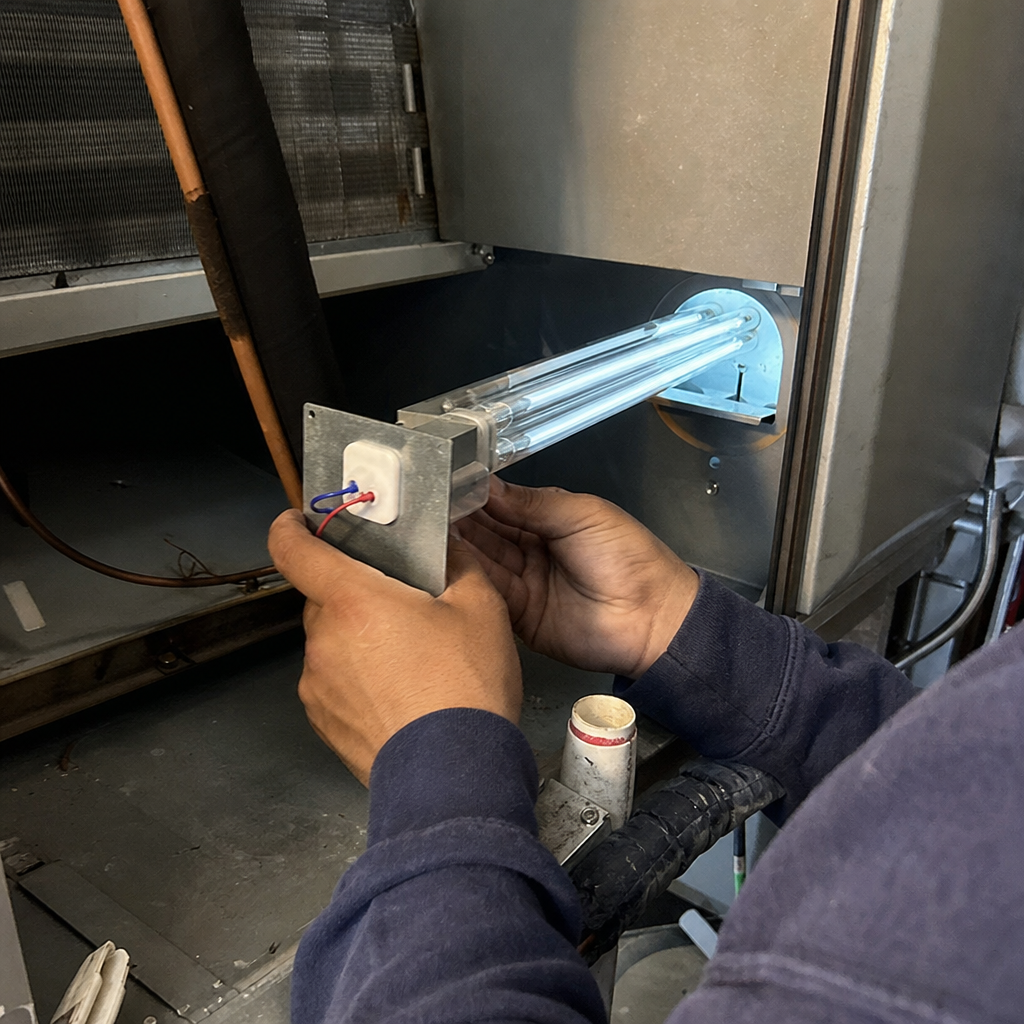
Installed in the air handler or ductwork, these lamps irradiate passing air and exposed surfaces. They’re continuous-treatment devices, not one-time sanitizing solutions. We specify Honeywell and Aprilaire UV systems when customers have ongoing concerns that justify the installation cost. They don’t replace periodic mechanical cleaning, but they can reduce microbial growth between cleanings.
HEPA-Filtered Negative Air Machines
These create pressure differentials that prevent cross-contamination during remediation work and capture airborne particles down to 0.3 microns. We use them during mold remediation projects and in commercial settings where occupant sensitivity is high. They’re part of the process, not the whole solution.
Most New York apartments don’t need all three. Some need none. The value of 11 years in one specialty is knowing which is which.
Why New York’s Housing Stock Makes This More Consequential
We’ve cleaned ducts in single-family homes on Long Island and in Westchester. The work is straightforward — one system, one building envelope, one set of occupants controlling their environment.
New York City is different. Your air quality is partially your neighbor’s air quality. We’ve documented:
- Co-op buildings in Riverdale where a single contaminated air handler fed multiple units through shared returns
- Pre-war walk-ups in the East Village with no ductwork at all — just plaster voids that function as distribution channels, impossible to clean conventionally and requiring modified approaches
- New construction in Long Island City with tightly sealed envelopes and minimal fresh air make-up, where any contaminant introduced persists longer than in leaky older buildings
- Buildings with through-wall PTAC units — common in Midtown and Downtown conversions — where “ductwork” is essentially a sleeve through concrete, and true sanitizing isn’t even physically possible
Steven’s familiarity with these building types comes from walking them personally, not from dispatching crews with standardized protocols. He’ll tell you whether your specific building infrastructure can even accommodate effective sanitizing before you spend money finding out the hard way.
Our Process and What to Expect
When you call (877) 542-5983, here’s what happens:
- Phone assessment — We ask about your building type, system age, any known water damage or pest history, and what symptoms prompted the call (odor, visible debris, health concerns, post-renovation dust)
- On-site inspection — Steven arrives, examines accessible ductwork and the air handler, and gives you a straight assessment of whether sanitizing is indicated
- Written estimate — No hidden fees, no “starting at” pricing that doubles on arrival
- Mechanical cleaning — Rotobrush and Nikro systems, full debris extraction
- Sanitizing treatment — Only if warranted, with EPA-registered product, proper dwell time, and ventilation
- Post-treatment verification — Visual inspection, system operation check, documentation for property managers or board requirements
Clean ducts aren’t a luxury — they’re just what the air in your home deserves.
FAQs
Residential air duct sanitizing in New York typically runs $275–$650, while commercial systems range from $800–$2,400 depending on system size and contamination severity. The lower end covers standard antimicrobial fogging after mechanical cleaning in a typical one- to two-bedroom apartment; the higher end reflects HEPA-negative-air protocols, post-treatment verification, or complex commercial shared-air systems. We provide written estimates before any work begins — call (877) 542-5983 for a free assessment.
No — cleaning removes debris mechanically, while sanitizing applies antimicrobial treatment to reduce biological contamination. Cleaning should always come first; applying sanitizer to dirty ducts is ineffective and can create worse problems by trapping moisture against organic material. We use Rotobrush and Nikro systems for the cleaning phase, then evaluate whether sanitizing is warranted based on what we find.
It depends on where the mold is and what caused it. Surface mold on accessible metal ductwork after a resolved moisture issue can often be addressed with mechanical cleaning plus EPA-registered antimicrobial treatment. Mold on porous materials like fiberboard, or mold resulting from ongoing leaks, requires remediation and material replacement — sanitizing alone won’t solve it. Steven assesses each situation personally and will tell you honestly whether our service is appropriate or if you need a mold remediation specialist first.
Ask four specific questions: Do they mechanically clean before sanitizing? What EPA-registered products do they use, and can they show you the label? What’s their dwell time and ventilation protocol? Who performs the work — the owner, employees, or subcontractors? At Empire, Steven Ramirez runs every job himself using Guardsman and Abatement Technologies products with documented procedures. Nearly 1,000 verified reviews back up our reputation as the best air quality sanitizing in New York, NY. If a company can’t answer these questions clearly, you’re likely getting theater, not sanitizing.
Ready for an Honest Assessment?
Don’t pay for duct sanitizing you don’t need — and don’t settle for a product sprayed into dirty ducts and called clean. Call (877) 542-5983 to speak with Steven directly, schedule a free on-site estimate, and get a straight answer about whether your New York system actually requires sanitizing or just needs thorough mechanical cleaning. Same-day appointments available across Manhattan, Brooklyn, Queens, and the Bronx.
Written by Steven Ramirez, Owner & Lead Technician at Empire Air Duct Cleaning Service New York, serving New York, NY.