
Last updated July 10, 2026
How to Hire a Air Duct Cleaning Contractor in New York City: A Step-by-Step Guide
The NYC Department of Consumer and Worker Protection fields complaints about air duct cleaning scams every single year — and here’s the part that stings: most victims say the warning signs were right there in front of them before the technician ever rang their buzzer. They just didn’t know what to look for. In a market as dense and competitive as New York City, the gap between a legitimate specialist and a bait-and-switch operation isn’t always obvious from a Google search. This guide walks you through exactly how to vet a contractor before you hand over a deposit, how to read an estimate like someone who knows the trade, and how to spot the red flags that separate real professionals from the ones who’ll leave your vents half-cleaned and your wallet lighter.
Quick Answer
To hire a legitimate air duct cleaning contractor in New York City, verify they carry proper HVAC-specific licensing (not just a general contractor’s license), request proof of liability insurance and workers’ compensation, demand a written estimate with line-item scope details, confirm who actually performs the work (owner-technician versus subcontracted crew), and ask for post-cleaning inspection documentation that meets NADCA standards. A 10-minute phone screen using these criteria eliminates most scam operators.
Table of Contents
- Step 1: Verify License and Insurance — What Documents Actually Matter in NY
- Step 2: Decode the Estimate — Line Items That Signal Legitimate Work
- Step 3: Phone Interview Questions That Expose Call Centers and Subcontractors
- Step 4: Cross-Reference Review History for Fake Patterns
- Step 5: Confirm Equipment and Actual Scope of Work
- Step 6: Demand Post-Cleaning Verification and NADCA Documentation
- New York City-Specific Considerations — Co-ops, Pre-War Buildings, and Climate
- Common Mistakes to Avoid
- When to Call a Professional
- Frequently Asked Questions
Step 1: Verify License and Insurance — What Documents Actually Matter in NY
New York State doesn’t hand out a specific “air duct cleaning license,” and that’s where the confusion starts. What separates legitimate operators from fly-by-nights isn’t a single magic certificate — it’s the combination of credentials they can produce when you ask.
Here’s what to request and why each matters:
- Home Improvement Contractor (HIC) license from the NYC Department of Consumer and Worker Protection — This is the baseline. Any contractor doing residential work in New York City must carry this. The license number should be verifiable on the DCWP website. If they hedge or claim they’re “exempt,” that’s an automatic disqualifier.
- EPA Section 608 Certification — If your duct cleaning touches the HVAC system itself (and in most New York City apartments and townhouses, it will), the technician needs this to handle refrigerants legally. General duct cleaning doesn’t always require it, but comprehensive HVAC cleaning does, and most legitimate firms do both.
- General liability insurance certificate — Request a certificate of insurance (COI) naming you or your building as additional insured. Minimum $1 million per occurrence is standard for this trade. The COI should come directly from their insurance broker, not a PDF they whipped up.
- Workers’ compensation coverage — In New York State, this is mandatory for any business with employees. If the person you’re talking to is a true solo operator, they may file for exemption, but they should be able to show that exemption certificate. If they have a crew and no workers’ comp, you’re exposed to liability if someone gets injured in your building.
The critical distinction: a general contractor’s license is not the same as HVAC-specific competency. We’ve been called into jobs in the Upper East Side and Park Slope where a GC’s crew attempted duct cleaning as an add-on to a renovation, used a shop vac and a brush on a drill, and left compacted debris in the main trunk lines. The homeowner paid twice — once for the ineffective work, once for us to do it properly with Rotobrush and Nikro rotary systems.
Ask specifically: “What HVAC or indoor air quality certifications do your technicians hold beyond the basic contractor license?” NADCA (National Air Duct Cleaners Association) certification for the company and at least one technician is the gold standard. Not every good firm has it, but every firm that has it has made a deliberate investment in legitimate training.
Step 2: Decode the Estimate — Line Items That Signal Legitimate Work
The bait-and-switch playbook is depressingly consistent in New York City. A low quote — often $49 to $89 for “whole house duct cleaning” — gets the technician through the door. Then the upsell begins: mold “discovered” in the camera, “required” sanitizing, extra charges per vent. The final bill runs $800 to $2,000, and the actual cleaning was superficial at best.
A legitimate estimate reads differently. Here’s what to look for:
| Vague/Problematic Language | Specific/Legitimate Language |
|---|---|
| “Full cleaning of all ducts” | “Supply trunk, return trunk, and up to 12 supply/return registers brushed and vacuumed with HEPA-contained negative air” |
| “Sanitizing included” | “Application of EPA-registered sanitizer to interior duct surfaces, product name specified, MSDS available on request” |
| “Mold remediation if needed” | “Visual inspection with borescope; third-party lab testing available; separate estimate for remediation if confirmed” |
| “Flat rate, no surprises” | “Base rate covers standard residential system; additional charges only for access modifications, excessive debris, or duct repair — detailed in writing” |
In our 11 years serving New York City, we’ve learned that transparency in estimating correlates directly with quality of work. Our estimates specify the Rotobrush or Nikro equipment we’ll use, the number of access points we’ll create, and whether we’re cleaning just ducts or the full HVAC including coils and blower. When a competitor won’t commit to that level of detail, it’s usually because they don’t plan to deliver that level of service.
Request the estimate in writing — email is fine — before anyone shows up. Verbal quotes are worthless if there’s a dispute. And never pay more than a nominal deposit (10-20%) before work begins. Full payment upfront is a massive red flag in this industry.
Step 3: Phone Interview Questions That Expose Call Centers and Subcontractors
Here’s a truth most New York City homeowners never consider: the friendly voice on the phone might be in a call center in another state, booking jobs for subcontractors who’ve never met the company’s owner and have zero accountability for quality.
Five questions that reveal who you’re actually dealing with:
- “Who will be the technician performing the work at my home?” — If the answer is “we’ll assign someone” or “our crew,” press harder. Legitimate owner-operated firms can name the person. At Empire, Steven runs the job himself — customers know exactly who’s showing up.
- “How long has that technician been with your company?” — High turnover means subcontracted labor or poor working conditions. Either way, not your problem. You want someone who’s been doing this specific work for years, not someone trained last week.
- “What equipment will you use, and can you describe how it works?” — A technician who actually runs the equipment can explain it. “Rotary brush with HEPA vacuum” is a real answer. “Professional-grade machinery” is not. We use Rotobrush and Nikro systems specifically because they’re the standard commercial and industrial contractors rely on — and we can tell you exactly why we choose one over the other for different building types.
- “What’s your policy if I’m not satisfied with the results?” — Reputable firms have a specific answer. “We’ll come back and address it” is the minimum. “No one has ever complained” is a dodge.
- “Can I speak directly with the technician before booking?” — If this is impossible or “against policy,” you’re dealing with a dispatcher model. The person doing your work should be willing to spend two minutes on the phone discussing your specific system.
In Manhattan and Brooklyn co-op buildings, this matters enormously. Superintendents and building managers often have specific access requirements, COI formatting rules, and time windows. A call center booking agent won’t know your building’s freight elevator hours. The technician will — if you can actually reach them.
Step 4: Cross-Reference Review History for Fake Patterns
With 982 reviews averaging 4.9 stars, we’ve spent considerable time understanding how review ecosystems work — including how competitors manipulate them. Here’s how to read between the lines on Google, Yelp, and other platforms:
- Timing clusters — Twenty 5-star reviews posted within a two-week period, especially for a company that’s been in business years, suggests a purchased review batch or a concerted solicitation campaign. Real review flow is irregular — some weeks busy, some quiet, some negative mixed in.
- Reviewer profile depth — Click through to the reviewer’s other activity. A profile with only one review ever, or only reviews for businesses in completely different cities, is suspect. Genuine local reviewers in New York City typically have reviews for restaurants, dry cleaners, other service providers in the area.
- Response language from the business — Template responses (“Thank you for your feedback!”) to every review suggest a reputation management service, not an engaged owner. Specific responses that reference details of the job indicate the person writing them actually knows the work. Steven personally responds to reviews when possible — he remembers the jobs because he was there.
- Review distribution — A perfect 5.0 with 50+ reviews is statistically unlikely. Our 4.9 reflects real human variation — some customers expected miracles, some had scheduling frustrations. A few 3- and 4-star reviews among many high ratings actually increases credibility.
- Photo evidence — Reviews with photos of the work, the technician, or the equipment carry more weight. In our experience, customers in neighborhoods like Gramercy Park and the West Village often document everything — it’s part of the culture. Absence of any visual evidence across dozens of reviews is a yellow flag.
Cross-reference multiple platforms. A company with 200 Google reviews and 3 Yelp reviews, or vice versa, may be concentrating review solicitation on one platform where manipulation is easier. Legitimate operations have presence across platforms proportional to their market presence.
Step 5: Confirm Equipment and Actual Scope of Work
The equipment question separates professionals from pretenders more reliably than almost any other screen. Here’s what legitimate duct cleaning requires and why the cheap alternatives fail:
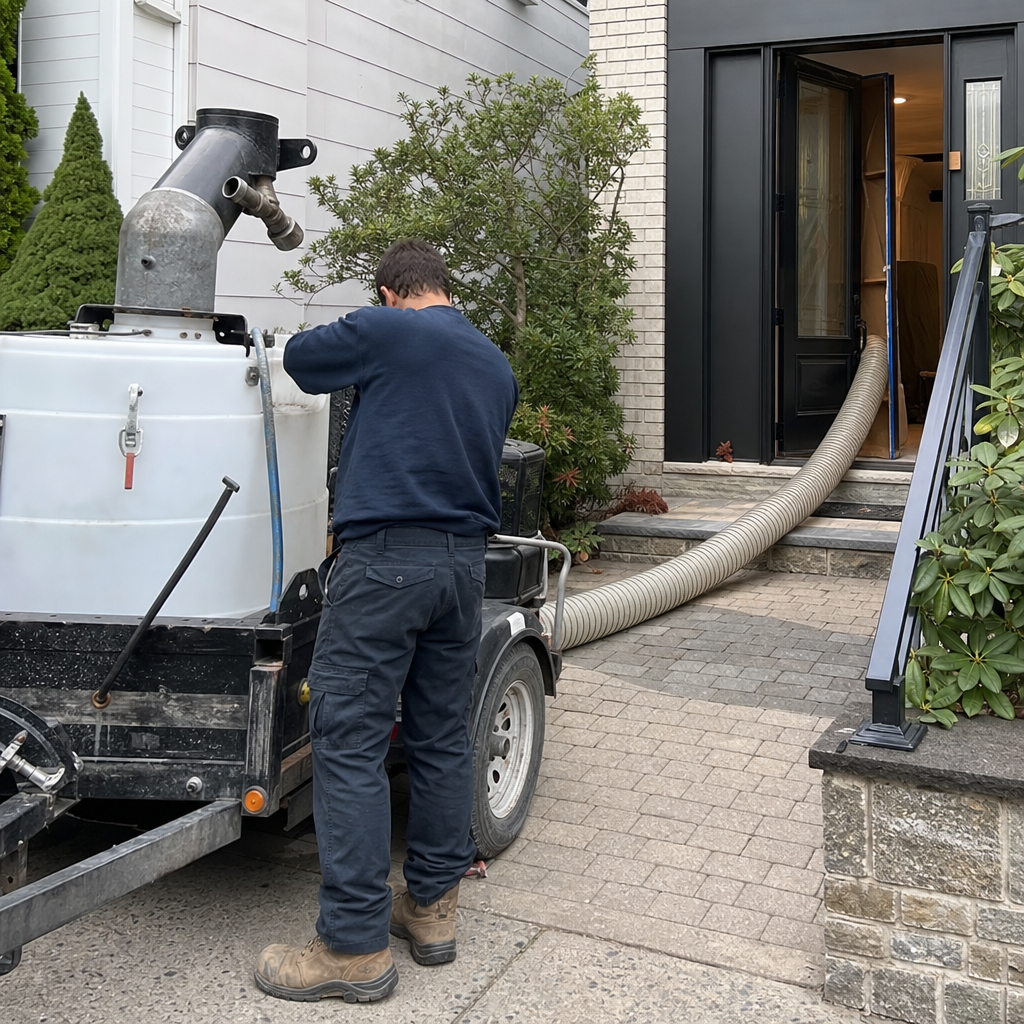
Rotary brush systems (Rotobrush, etc.) — A powered brush head on a flexible cable that traverses the duct, dislodging debris while a vacuum extracts it. Essential for rectangular ductwork common in pre-war New York City buildings, where debris compacts in corners that air-wash systems miss.
Negative air/HEPA vacuum systems (Nikro, etc.) — Creates suction throughout the duct system so dislodged debris is captured, not redistributed into your living space. Required by NADCA standards for contained cleaning.
Borescope/inspection camera — For pre- and post-cleaning documentation. If a contractor can’t show you before-and-after footage from inside your ducts, they can’t prove they did the work.
Access tools — Proper cutting and sealing of access panels, not prying open existing registers and hoping for the best.
The scope of work should explicitly state:
- Number of supply and return registers to be cleaned
- Whether trunk lines (main ducts) are included or excluded
- HVAC component cleaning — coils, blower, plenum — or duct-only
- Access creation and restoration method
- Contamination control measures during work
In New York City’s older housing stock, particularly in neighborhoods like the West Village, Gramercy Park, and Brooklyn Heights, we regularly encounter asbestos-containing duct insulation and vermiculite. A legitimate contractor identifies these hazards before disturbing them, has protocols for safe handling, and knows when to bring in abatement specialists. Our equipment includes Abatement Technologies containment systems for these scenarios — it’s not standard on every job, but it’s available when needed.
Step 6: Demand Post-Cleaning Verification and NADCA Documentation
The job isn’t done when the truck leaves. NADCA Standard 2021 (the current industry benchmark) specifies what documentation a professional cleaning should produce:
- Pre-cleaning inspection report — Visual assessment, often with borescope images, documenting system condition before work begins.
- Post-cleaning verification — Repeat inspection showing debris removal. This should be photographic or video evidence you can review, not a verbal “looks great.”
- System performance check — Confirmation that all access panels are sealed, registers reinstalled, and system operates normally post-cleaning.
- Written completion statement — What was done, when, by whom, with equipment serial numbers or identification if required for warranty purposes.
In our work across New York City, we’ve found that buildings with central HVAC systems — common in newer construction in Long Island City, Downtown Brooklyn, and Battery Park City — particularly benefit from documented airflow verification. We check static pressure and airflow at registers before and after cleaning when possible, using calibrated instruments. This isn’t always necessary for simple duct cleaning, but it’s part of our protocol for full HVAC cleaning engagements.
Contractors who resist documentation, who “forgot” to take after photos, or who claim “you can just tell it’s cleaner” are telling you something important about their standards. The work should be provable.
New York City-Specific Considerations — Co-ops, Pre-War Buildings, and Climate
New York City’s built environment creates unique duct cleaning challenges that generic guides never address.
Co-op and condo board requirements — Most Manhattan and Brooklyn co-ops require Certificate of Insurance naming the building, specific work-hour restrictions, and sometimes superintendent escort. We’ve developed relationships with building staff across the city because we work in the same buildings repeatedly. A contractor unfamiliar with co-op protocols will waste your time and potentially violate house rules.
Pre-war construction — Buildings from the 1920s-1940s often have transom ducts, plaster-and-lath chase walls used as air passages, and original metal ductwork with decades of accumulated debris. These systems can’t be cleaned with standard residential approaches. We assess accessibility during our initial site visit and specify modified scope when needed.
Climate and seasonal timing — New York City’s humidity swings mean mold risk in ductwork peaks in late summer, while heating-system debris circulates most aggressively when furnaces first fire in October-November. Spring and early fall are optimal booking windows — contractors have availability, and you’re addressing problems before peak season. We’ve seen emergency call volume spike 40% in the first cold snap when neglected systems fail.
Neighborhood-specific building types — In Gramercy Park, we regularly service classic six and seven-room apartments with original radiator systems retrofitted with central air. In Gramercy Park and similar pre-war areas, dryer vent routing often violates modern codes — long horizontal runs through walls that trap lint and create fire hazards. Our HVAC cleaning in Gramercy Park accounts for these architectural realities.
Common Mistakes to Avoid
- Booking based on price alone — The $89 “whole house special” is a loss-leader designed to get a salesperson into your home. Legitimate duct cleaning in New York City costs $400–$900 for a typical 2-3 bedroom apartment, depending on system complexity. Below that threshold, something’s being cut — usually labor time, equipment quality, or scope.
- Accepting verbal estimates — Without written scope, you have no recourse when the “included” sanitizing suddenly costs extra. Every line item should be specified before work begins.
- Ignoring insurance verification — We’ve seen technicians injured in walk-up buildings, water damage from improper containment, and scratched floors from careless equipment handling. The COI takes 24 hours to obtain. A contractor who can’t provide it isn’t properly insured.
- Assuming all “five-star” companies are equal — Review volume matters more than perfect scores. A company with 50 five-star reviews and 2 years in business has less proven consistency than one with nearly 1,000 reviews across 11 years, even with occasional lower ratings.
- Neglecting to ask about the actual technician — The person who answers the phone is rarely the person who does the work. In owner-operated firms, they’re the same. That’s a meaningful quality indicator.
- Skipping post-cleaning inspection — You wouldn’t pay a painter without looking at the walls. Don’t pay a duct cleaner without seeing proof the debris is gone.
- Hiring generalist HVAC companies for duct specialization — Duct cleaning as a sideline business usually means outdated equipment and technicians trained primarily for installation or repair, not cleaning protocol. We focus exclusively on air duct and indoor air quality work — it’s the only thing we do.
When to Call a Professional
Certain situations in New York City demand immediate professional attention rather than scheduled maintenance. Call a specialist if you notice visible mold growth inside ducts or on vents, persistent musty odors when HVAC runs, sudden increase in dust accumulation despite regular cleaning, reduced airflow from specific registers, or signs of pest infestation in ductwork. After any renovation involving drywall, sanding, or demolition, ducts should be inspected — construction debris in New York City’s tight spaces inevitably finds its way into returns.
Empire Air Duct Cleaning Service New York offers free estimates throughout New York City — call (877) 542-5983. Steven Ramirez personally evaluates each project and specifies the appropriate scope, equipment, and timeline. With 11 years of exclusive focus on air duct and indoor air quality work, we’ve encountered virtually every building type and system configuration in the five boroughs.
Frequently Asked Questions
For a typical 2-3 bedroom apartment in New York City, expect $400–$900 for thorough duct cleaning; larger homes, townhouses, or systems with complex access issues range $800–$1,500. Prices below $300 typically indicate limited scope, bait-and-switch tactics, or equipment inadequate for proper debris removal. Call (877) 542-5983 for a free written estimate with line-item detail — no surprises.
Every 3-5 years for typical residential systems; annually if you have allergies, asthma, pets, or recent renovation. New York City’s older buildings with shared walls and potential rodent pathways may need more frequent inspection. In our experience, pre-war buildings in Manhattan and Brooklyn often benefit from 2-3 year intervals due to accumulated decades of debris in original ductwork.
Duct cleaning addresses the distribution pathways — supply and return ducts, registers, and grilles. HVAC cleaning includes the mechanical components: evaporator coils, blower assembly, condensate pan, and heat exchanger. For complete system restoration, both are necessary. Empire provides both services, using equipment from Honeywell and Aprilaire for component-specific cleaning when appropriate.
Moderately, if airflow restriction was significant. The Department of Energy estimates 25-40% of heating/cooling energy is wasted, but duct leakage and insulation are bigger factors than interior debris. Where cleaning helps most is system longevity and indoor air quality — reduced strain on blower motors, fewer contaminants circulating. We measure airflow before and after when possible to document improvement.
Verify DCWP Home Improvement Contractor license, request Certificate of Insurance, confirm EPA 608 certification for HVAC work, ask specific equipment questions, and demand written scope with line items. Legitimate operators answer directly; scammers deflect to urgency or pressure. Nearly 1,000 customers reviewed us because we welcome scrutiny — it’s how we built our reputation.
More common than most residents realize, especially in buildings with chronic humidity issues or poorly maintained condensate drainage. However, not every dark spot is mold — dust and debris can look similar. We use borescope inspection and, when indicated, recommend third-party lab testing before any remediation. Never accept “mold” diagnosis without visual proof from a camera you can see.
The Bottom Line
Hiring a legitimate air duct cleaning contractor in New York City requires the same diligence you’d apply to any significant home service — but the city’s dense market of competing claims makes verification essential. The red flags are visible before anyone arrives: vague estimates, unverifiable licenses, call-center booking, template reviews, and resistance to documentation. The markers of legitimacy are equally clear: specific equipment knowledge, transparent pricing, owner accountability, and provable results. Take 20 minutes to screen using the steps above, and you’ll eliminate most problem operators before they reach your door.
Written by Steven Ramirez, Owner & Lead Technician at Empire Air Duct Cleaning Service New York, serving New York City since 2015.