
Last updated July 10, 2026
Seasonal Air Duct Cleaning Care for New York City: Year-Round Homeowner’s Guide
Here’s what most New York City homeowners get wrong: spring feels like the cleanest season indoors, but it’s actually when fungal spore counts inside ductwork peak. After months of steam heat or gas-fired systems running, metal duct surfaces stay cold well into April. When warm, humid air finally enters, condensation forms on those chilled surfaces—creating a narrow two-to-three-week window where mold establishes itself before temperatures equalize. We’ve pulled rotary brushes through Gramercy Park co-op ducts in late April and found active mold colonies that didn’t exist in February. This guide breaks down how each of New York City’s four seasons creates distinct contamination profiles inside your duct system, and exactly when to inspect, clean, and protect your air quality.
Quick Answer
New York City homeowners should schedule professional air duct cleaning twice yearly—late October before heating season and mid-April after the spring condensation risk window—supplemented by quarterly homeowner inspections of visible registers, filter conditions, and dryer vent airflow. This 12-month calendar aligns with NYC’s specific seasonal air quality threats: combustion byproducts in winter, mold spore surges in spring, ozone and PM2.5 infiltration during summer AC operation, and renovation dust peaks in fall.
Table of Contents
- Winter: Combustion Byproducts and Mixed Mechanical Buildings
- Spring: The Hidden Mold Window Nobody Talks About
- Summer: Pressure Cycling and Rooftop Particulate
- Fall: Renovation Season and Multi-Unit Contamination
- Your 12-Month NYC Duct Maintenance Calendar
- What Professional-Grade Cleaning Actually Looks Like
- Common Mistakes to Avoid
- When to Call a Professional
- Frequently Asked Questions
Winter: Combustion Byproducts and Mixed Mechanical Buildings
New York City’s heating infrastructure creates a contamination profile unlike anywhere else in the country. In pre-war buildings throughout the Upper West Side, Greenwich Village, and Gramercy Park, steam heat from basement boilers shares wall and ceiling chases with forced-air ductwork installed decades later. We’ve documented this repeatedly: combustion gases—including carbon monoxide, sulfur dioxide, and fine particulate—migrate through gaps in chase enclosures and enter supply ducts that should carry only conditioned air.
The problem intensifies in buildings with mixed mechanical systems. A client in a Murray Hill condo saw elevated CO readings near their bedroom register every January; the source was a corroded boiler exhaust collar three floors down, leaking into a shared plenum. This isn’t a boiler repair issue alone—once those combustion byproducts coat duct interiors, they become reservoirs that off-gas continuously and provide sticky surfaces for dust accumulation.
What to check in winter:
- Register discoloration: black or gray staining around supply vents indicates particulate infiltration
- Odor patterns: a persistent “heating smell” that doesn’t dissipate after the first two weeks of operation suggests contamination, not normal seasonal startup
- Humidity paradox: steam-heated apartments often hit 15% relative humidity, drying nasal passages and making occupants more susceptible to irritation from any airborne contaminants
- Filter loading: standard 1-inch pleated filters in forced-air systems clog faster when fine combustion particulate is present—check monthly, not quarterly
In our 11 years of exclusive duct and indoor air quality work across New York City, the week after Christmas brings the highest volume of “something smells wrong” calls. Homeowners have been running heat continuously for four to six weeks, and cumulative contamination reaches perceptible thresholds. We use Nikro portable HEPA vacuums and Rotobrush rotary systems to remove these deposits mechanically—chemical treatments alone won’t break the bond between combustion residue and galvanized duct metal.
Winter also stresses dryer vent systems. In buildings where exterior vent terminals ice over—a common issue on north-facing exposures above 15 stories—lint backs up into the duct run and creates fire risk. Dryer vent cleaning in Gramercy Park and similar pre-war neighborhoods becomes critical maintenance, not optional service, when temperatures stay below freezing for extended periods.
Spring: The Hidden Mold Window Nobody Talks About
The critical period runs approximately April 8 through April 28 in New York City, though we’ve seen it shift earlier in warm springs and extend into early May during cool, wet years. Here’s the mechanism: duct metal chilled by 150+ days of heating operation—often to temperatures 15–20°F below ambient—meets the first sustained warm, humid air masses. Condensation forms on interior surfaces before the thermal mass of the duct system equalizes.
This isn’t theoretical. In 2023, we inspected a Park Slope brownstone’s duct system on April 12 and found active Cladosporium growth on the upstream side of the evaporator coil housing—exactly where cold metal met humid return air. The homeowner had opened windows for “spring fresh air” three days prior, inadvertently accelerating the moisture load.
The spring contamination sequence:
- Heating shutdown: Boiler or furnace cycles off, ending the drying effect of warm airflow
- Thermal lag: Duct metal remains cold for 10–20 days depending on insulation quality and building mass
- Humidity spike: Outdoor dew points rise above 55°F; windows open, or HVAC switches to ventilation mode
- Condensation phase: Interior duct surfaces reach dew point; moisture accumulates in low-velocity zones
- Mold establishment: Spores—always present at low levels—germinate within 48–72 hours on nutrient-rich dust layers
- Equalization: Ducts finally warm; condensation stops, but established colonies continue sporulating
Post-war buildings with exterior ductwork in unconditioned spaces—common in 1960s-era high-rises from Battery Park City to Roosevelt Island—experience this most severely. The ducts never had proper insulation, and decades of thermal cycling have degraded what remained.
Our protocol: we schedule intensive cleaning appointments for the last two weeks of April, using Rotobrush agitation followed by negative-pressure HEPA extraction. For systems with visible mold, we apply EPA-registered antimicrobial through Abatement Technologies fogging equipment, then verify clearance with air sampling. The key is timing—treat before colonies establish deep in fiberglass-lined ductboard, where mechanical cleaning alone won’t reach.
Summer: Pressure Cycling and Rooftop Particulate
Central air conditioning in New York City operates under conditions that fundamentally differ from heating mode. In winter, supply air is heated and expands, creating positive pressure that tends to push conditioned air out through leaks. In summer, cold supply air contracts, and the air handler’s blower creates negative pressure in return plenums—actively drawing unconditioned air into the system through any gap.
This pressure reversal has a specific consequence in NYC’s building stock. Rooftop-mounted condensers and air handlers draw intake air from among water towers, exhaust vents, and often decades of accumulated tar and gravel particulate. When return ducts leak—virtually guaranteed in buildings over 30 years old—that rooftop air gets pulled directly into the circulation path.
We’ve measured PM2.5 levels in return plenums during July operations that exceeded outdoor ambient by 40%, entirely due to this infiltration pathway. The summer of 2023 brought multiple ozone alert days to New York City; on those days, ozone-laden rooftop air was being concentrated and distributed through duct systems with compromised integrity.
Summer-specific inspection points:
- Return register airflow balance: if one bedroom has noticeably weaker suction than others, the return path has likely developed a leak pulling attic or shaft air instead
- Condensate drainage: overflowing drain pans create secondary moisture sources in already-humid conditions
- Filter bypass: pressure differentials in summer are higher; poorly fitted filters allow unfiltered air around edges
- Supply register temperature consistency: cold spots indicate restricted airflow, often from mold established in spring now restricting passages
Our HVAC cleaning in Gramercy Park and throughout Manhattan addresses this with full-system pressure testing before mechanical cleaning. We identify leakage points, then clean coils, blowers, and duct runs as an integrated system—because summer contamination moves between components in ways that isolated cleaning misses.
The equipment matters here. We use Nikro high-velocity vacuums rated for commercial CFM requirements, not residential-grade units that lose suction across long vertical duct runs. In 15-story buildings common to the East Side, that power differential determines whether rooftop-facing return lines actually get cleared or just surface-cleaned.
Fall: Renovation Season and Multi-Unit Contamination
October through November is the highest-volume renovation period in New York City, driven by co-op board schedules, lease turnovers, and homeowners completing projects before holiday hosting. This has direct, measurable consequences for duct systems in attached and multi-unit buildings.
Construction particulate—gypsum dust, joint compound, hardwood sanding residue, and demolition debris—migrates through shared walls, floors, and mechanical chases in ways that surprise most homeowners. We’ve traced drywall dust in a Lincoln Square apartment’s supply ducts to a renovation four floors down and two units over, traveling through a garbage chase that shared a poorly sealed wall with the duct riser.
The fall contamination profile differs from other seasons in being primarily particulate rather than biological or chemical. It’s also the most preventable through proactive scheduling. A thorough cleaning in late October—before heating season begins circulating these deposits—establishes baseline cleanliness that lasts through winter.
Fall risk factors specific to NYC housing stock:
- Pre-war buildings with plaster lath walls: renovation vibration dislodges decades of accumulated dust into wall cavities that communicate with duct chases
- Co-op buildings with coordinated renovation windows: multiple units under construction simultaneously compound migration
- Buildings with through-wall AC sleeves: removed units leave openings that communicate between apartments and with exterior shaft air
- New construction “luxury” rentals: rushed final cleaning leaves construction residue in ducts that first tenants inherit
In our experience, the worst fall contamination we’ve encountered was in a 2022-completed building in Long Island City. The developer’s duct cleaning was cursory; within six weeks of occupancy, residents reported visible dust plumes when heat first activated. We spent three days per floor with Rotobrush systems and HEPA containment, removing construction residue that should never have been left. The air duct cleaning in Gramercy Park and similar established neighborhoods typically involves older, layered contamination rather than acute construction debris—but the principle holds: fall is when you establish cleanliness before systems go into continuous operation.
Your 12-Month NYC Duct Maintenance Calendar
Based on the seasonal patterns above, here’s a schedule we’ve refined through 11 years of New York City service. It balances professional intervention with homeowner monitoring.
Professional Service Appointments (2x/year):
| Timing | Service | Focus |
|---|---|---|
| Late October | Full system cleaning & inspection | Remove summer contamination, address fall renovation debris before heating season |
| Mid-April | Post-winter deep clean & mold assessment | Eliminate combustion residue, inspect for spring mold establishment, verify condensate drainage |
Homeowner Inspection Dates (4x/year):
- First Saturday in January: Check all supply and return registers for discoloration or odor. Replace filters. Verify dryer vent exterior termination is clear of ice/snow.
- Weekend before Memorial Day: Inspect accessible duct runs in basement or utility closet for condensation signs. Check AC condensate drain flow. Note any musty odors when system first switches to cooling.
- Labor Day weekend: Replace filters before heavy AC use ends. Inspect outdoor condenser intake area for debris accumulation. Document any summer performance issues for professional follow-up.
- Columbus Day weekend: Walk building if in multi-unit; note any active renovations. Check with building management about scheduled work that might affect your unit. Schedule October professional appointment if not already booked.
This calendar assumes a standard forced-air system in a New York City building with typical seasonal operation. Steam-heated apartments with PTAC units or mini-splits require modified schedules—we assess these individually during initial consultation.
What Professional-Grade Cleaning Actually Looks Like
There’s a meaningful difference between duct cleaning that moves dust around and duct cleaning that removes it. We’ve been called to correct jobs where previous operators used shop vacuums with inadequate filtration, leaving systems dirtier than when they started.
Our process, refined over 982 verified jobs:
- Pre-inspection with video: We run cameras through accessible duct runs before touching anything. This documents baseline conditions and identifies damage, previous repairs, or construction debris that affects our approach.
- Containment setup: Negative pressure HEPA filtration at the air handler prevents redistribution during cleaning. In occupied apartments, we seal registers and work zone-by-zone.
- Mechanical agitation: Rotobrush rotary systems with nylon or steel bristle heads—selected based on duct material—loosen adhered deposits. The brush head is sized to the duct diameter; oversized brushes damage flex duct, undersized ones polish surfaces without cleaning.
- Simultaneous extraction: Nikro vacuum systems operating at sufficient CFM capture dislodged material at the point of agitation. This “source removal” approach is the NADCA-recommended standard; agitation without simultaneous extraction just relocates contamination.
- Component cleaning: Blower wheels, evaporator coils, and drain pans receive dedicated attention. These components interact with ductwork continuously; cleaning one without the others is incomplete.
- Verification: Post-cleaning video inspection confirms results. We provide documentation to clients, particularly valuable for co-op board requirements or property management records.
For air quality sanitizing, we deploy Honeywell and Aprilaire whole-home solutions integrated with existing HVAC controls, or Abatement Technologies portable systems for targeted treatment. These aren’t replacement for mechanical cleaning—they’re complementary layers for households with allergy concerns, recent illness, or post-remediation verification needs.
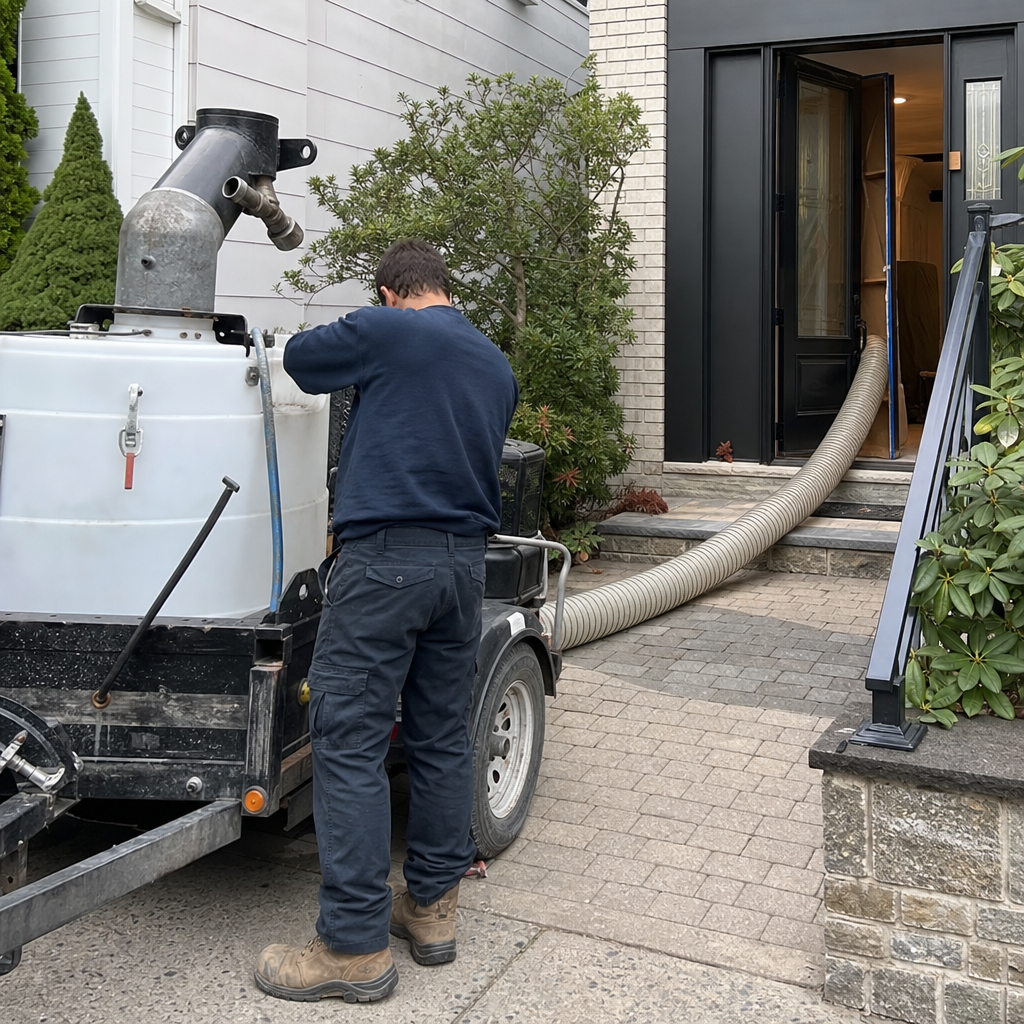
Steven runs every job himself. The person who answers your call, assesses your system, operates the equipment, and verifies results is the same individual. That’s not typical in this industry, where most companies dispatch crews with minimal training and no decision-making authority. Our 4.9-star average across nearly 1,000 reviews reflects what happens when the owner has personal accountability for every outcome.
Common Mistakes to Avoid
- Assuming spring opening of windows “airs out” ducts. In New York City’s humidity, this often introduces the moisture that triggers mold growth on cold duct surfaces. Mechanical ventilation or controlled dehumidification is safer.
- Ignoring dryer vents until clothes stop drying. Extended dry times indicate dangerous lint accumulation. In NYC’s vertical vent runs—often 30+ feet through multiple floors—this is a fire hazard that develops faster than in single-story construction.
- Accepting “blow-and-go” cleaning with no inspection. Operators who don’t video-inspect before and after cannot verify results. We’ve found collapsed flex duct, disconnected returns, and even a deceased rodent that no-touch blow cleaning would have left in place.
- Using the wrong filter MERV rating. High-MERV filters (13+) in systems not designed for the pressure drop strain blowers and create leaks. Most NYC pre-war forced-air retrofits perform best with MERV 8–11, changed more frequently.
- Delaying post-renovation cleaning. Construction dust contains respirable crystalline silica and other hazardous particulates. The longer it remains in ducts, the more integrates into porous surfaces and the harder it becomes to fully remove.
- Treating steam heat and forced-air systems identically. Steam-heated apartments with window AC units have minimal ductwork but often have through-wall sleeves, PTACs, or exhaust fans that require distinct maintenance protocols.
- Neglecting building-wide coordination. In co-ops and condos, individual unit cleaning has limited benefit if common risers remain contaminated. We work with building management to assess whether partial or full-system cleaning is appropriate.
When to Call a Professional
Certain scenarios in New York City require immediate professional assessment rather than continued monitoring. Call for inspection if you detect persistent musty odors when systems activate, visible mold around registers, unexplained increases in dust accumulation, or symptoms that worsen when you’re home and improve when away. After any building-wide renovation, fire, or water damage event, duct inspection should be standard protocol—not optional.
Empire Air Duct Cleaning Service New York offers free estimates throughout New York City. Steven Ramirez personally evaluates each system and provides specific recommendations without pressure. Call (877) 542-5983 to schedule. For immediate concerns, we maintain availability for urgent assessments, particularly when mold or combustion byproduct exposure is suspected.
Frequently Asked Questions
For most NYC residences, every 12–18 months is appropriate, with twice-yearly service optimal for households with allergies, pets, or recent renovation exposure. The specific interval depends on building age, mechanical system type, and seasonal stressors like the spring mold window and fall construction period. Call (877) 542-5983 and we’ll assess your particular situation—estimates are free.
Yes, specifically mid-April in New York City, when cold duct metal meets the first sustained warm, humid air masses. Most homeowners assume spring is the cleanest season because windows are open, but the thermal lag in duct systems creates a 2–3 week condensation window that peaks mold risk. We recommend professional inspection during this period, especially in pre-war buildings with uninsulated duct chases.
Typical residential service ranges from $400–$800 for a standard apartment or townhouse unit, with factors including duct accessibility, system size, and contamination severity. Co-op buildings with common riser requirements or post-renovation construction debris may run higher. We provide exact quotes after visual inspection—never over-the-phone guesses. Call (877) 542-5983 for your free estimate.
Homeowners can and should perform quarterly register inspections, filter changes, and dryer vent terminus checks. However, mechanical cleaning of internal duct runs requires professional equipment—Rotobrush or equivalent rotary systems with simultaneous HEPA extraction—to avoid damaging ductwork or redistributing contamination. In New York City’s vertical buildings with long duct runs, DIY attempts are rarely effective and sometimes harmful.
A brief odor during first seasonal startup is normal as dust burns off heat exchangers. If the smell persists beyond two weeks, intensifies, or includes acrid or sulfurous notes, it indicates combustion byproduct infiltration or accumulated contamination requiring professional cleaning. In mixed-mechanical NYC buildings, this often signals exhaust gas migration into duct chases—a safety issue, not merely an air quality concern.
Yes, we regularly work with co-op and condo boards throughout Manhattan and Brooklyn, providing the documentation, insurance certificates, and scheduling flexibility these buildings require. Our 982 verified reviews include extensive feedback from NYC co-op residents, and Steven personally coordinates with building management to minimize disruption to common areas and neighboring units.
The Bottom Line
New York City’s four seasons create four distinct contamination profiles inside duct systems: combustion byproducts in winter, mold establishment in spring’s condensation window, rooftop particulate infiltration during summer AC operation, and construction debris migration in fall renovation season. A proactive 12-month calendar—professional cleaning in late October and mid-April, quarterly homeowner inspections—addresses each threat at optimal timing. The equipment and operator matter: Rotobrush and Nikro systems in experienced hands remove contamination rather than relocating it. With 11 years of exclusive focus on air duct and indoor air quality work, we’ve refined these protocols through nearly 1,000 verified customer experiences across every NYC building type.
Ready to protect your home’s air quality through every season? Call Empire Air Duct Cleaning Service New York at (877) 542-5983 for a free estimate. Steven Ramirez will assess your system personally and build a maintenance schedule matched to your building’s specific mechanical profile and seasonal risks.
Written by Steven Ramirez, Owner & Lead Technician at Empire Air Duct Cleaning Service New York, serving New York City since 2015.