
Furnace Duct Cleaning Cost in New York: What You’ll Actually Pay for a Full System Cleaning
Furnace duct cleaning in New York typically costs between $450 and $950 for a complete residential job, including supply ducts, return ducts, and the air handler unit. For detached homes in Queens, Staten Island, or the Bronx with older forced-air systems, expect to land in the $650–$950 range due to accumulated combustion residue from historic oil-to-gas conversions. Call (877) 542-5983 for a free, exact quote — Steven runs every estimate himself and prices by what your system actually needs, not by square footage alone.
Why New York’s Outer-Borough Housing Changes the Price Equation
Most online pricing for “furnace duct cleaning” assumes a suburban tract home built in the 1990s with clean fiberglass ductboard. That’s not what we walk into in New York.
Across Queens neighborhoods like Jackson Heights, Bayside, and Flushing — where Steven grew up watching his uncle work HVAC — thousands of detached and semi-detached homes converted from oil to gas heating between 2000 and 2015. The utility ran the new gas line. The plumber swapped the burner. But almost nobody cleaned the ducts afterward.
What we find inside those systems is a layered cake of problems: black carbonized soot from decades of oil combustion, rust scale from galvanized steel ducts installed in the 1950s–1970s, and modern household dust packed on top. This isn’t standard dust accumulation. It’s a different cleaning challenge that takes longer, requires more aggressive mechanical action, and produces dramatically more debris.
In Staten Island’s Tottenville or Great Kills, or the Bronx’s Pelham Bay and Throgs Neck, we see the same pattern. The furnace works fine on gas now, but every time the blower kicks on, it’s pushing residual combustion byproduct through your living space. No MERV-13 filter catches this — it’s already inside the system.
This is why our pricing for these homes runs higher than the $299 “whole house specials” you’ll see advertised. Those operations budget 90 minutes and a shop vac. We budget half a day and industrial-grade rotary equipment, because that’s what the housing stock demands.
What a Complete Furnace Duct Cleaning Includes — and What It Should Cost
When we quote furnace duct cleaning, we’re pricing a scope of work, not a room count. Here’s what Empire includes and what each component costs in the New York market:
| Service Component | Typical Range (NYC) |
|---|---|
| Supply duct cleaning (all branches) | $180 – $320 |
| Return duct cleaning (trunk + branches) | $150 – $280 |
| Air handler / blower compartment cleaning | $120 – $220 |
| Coil cleaning (evaporator, if accessible) | $80 – $150 |
| System sanitizing treatment | $75 – $125 |
| Complete furnace duct system | $450 – $950 |
The low end of that range covers a straightforward job: newer flex duct in good condition, minimal debris, accessible air handler in a basement or utility closet. The high end reflects what we more commonly encounter in New York’s older housing — multiple stories of galvanized hard pipe with crimped joints, restricted access through crawl spaces or finished basements, and the heavy soot loads from prior oil service.
We don’t quote by bedroom count because that’s a gimmick. A “three-bedroom house” in Forest Hills might have 12 duct runs and a compact air handler, while a similar house in Jamaica Estates could have 20 runs, a buried oil tank still in the ground, and ducts that haven’t been opened since the Eisenhower administration. Steven assesses each system in person before setting a fixed price.
Why the Air Handler Matters as Much as the Ducts
Here’s where a lot of competitors cut corners: they’ll run a brush through your supply and return ducts, show you a vacuum full of dust, and call it done. But the blower compartment, heat exchanger, and evaporator coil are where the real buildup happens — and where your system’s efficiency and your indoor air quality are actually determined.
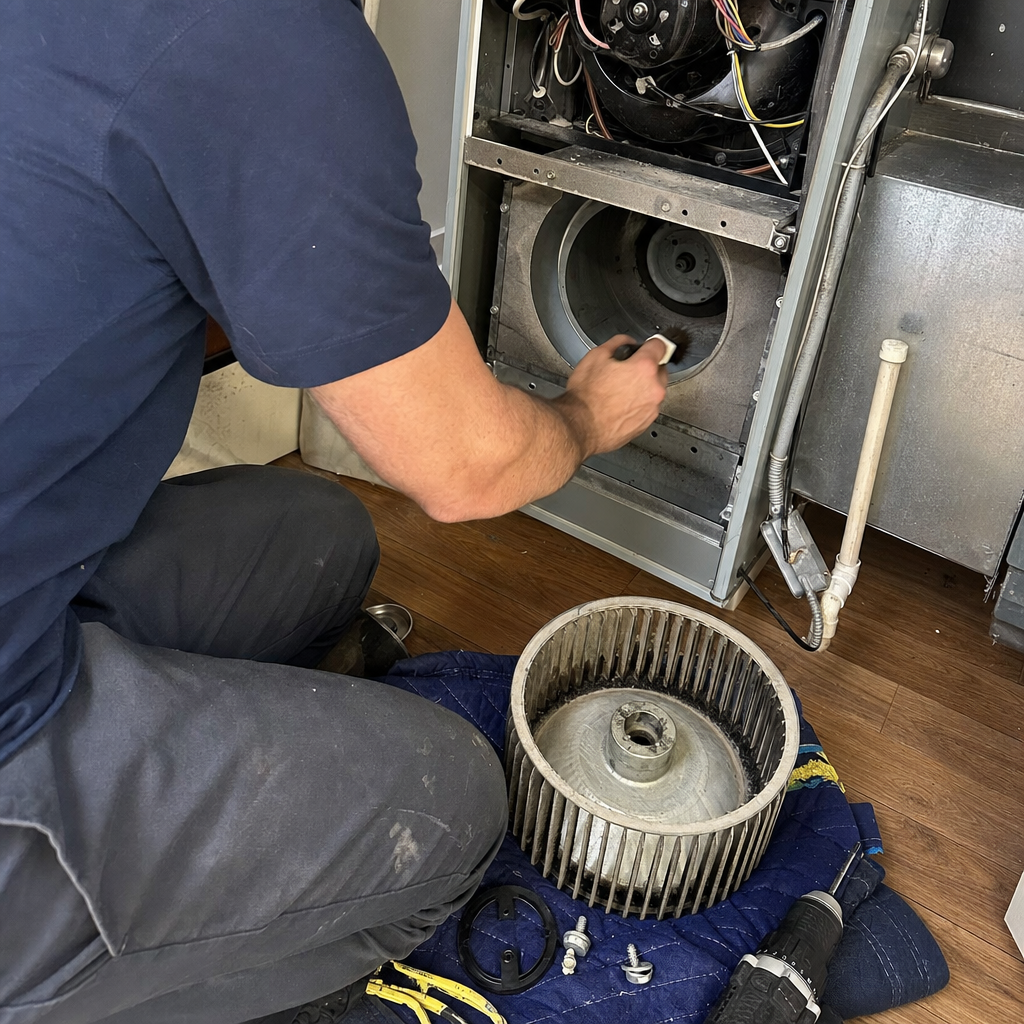
When we clean a furnace duct system, we pull and clean the blower assembly, inspect the heat exchanger for soot staining that indicates incomplete combustion, and clean the evaporator coil if it’s accessible without cutting refrigerant lines. This is standard scope for us, not an upsell. A duct system with a dirty blower is like washing your car and leaving mud caked on the engine.
Our HVAC Cleaning page details the full mechanical scope, but for furnace-specific work, the blower compartment cleaning is non-negotiable. We’ve seen systems where the blower wheel was so clogged with oily residue that it was drawing 40% more amperage than spec — which means higher Con Edison bills and premature motor failure.
Rotobrush vs. Air-Whip: What Works in New York’s Older Duct Systems
Equipment choice matters for pricing because it determines both thoroughness and risk to your system. We use Rotobrush rotary brush systems and Nikro high-velocity vacuums — the same combination specified by commercial and industrial contractors — because they’re what New York’s housing stock demands.
Here’s how the methods compare for the duct types we actually encounter:
- Rotary brush (Rotobrush): A spinning nylon or cable brush scrubs the duct wall while a vacuum extracts debris. This is our default for galvanized steel ducts with crimped joints — the kind installed in Queens and Staten Island homes from the 1950s through 1970s. The mechanical action breaks loose soot that’s bonded to the metal surface. We adjust brush stiffness based on duct condition; older galvanized with internal rust gets softer bristles to avoid wall damage.
- Air-whip / compressed air methods: These use high-pressure air nozzles to agitate debris. They work well for newer flex duct or metal duct in good condition, but they’re less effective on heavy soot loads and can actually pack wet, oily residue deeper into porous surfaces. We occasionally supplement with air-whip tools for finished duct runs where brush access is limited, but we never rely on them as primary cleaning for oil-conversion systems.
- Negative air / HEPA containment: Our Nikro vacuum systems maintain negative pressure throughout the cleaning, so nothing escapes into your living space. This is especially critical in New York’s tighter homes — row houses, attached duplexes, apartments with shared walls — where containment failures affect neighbors, not just your own air quality.
The equipment investment is part of why our pricing sits where it does. A Rotobrush system with proper HEPA containment runs $15,000–$25,000. The shop-vac-and-compressor rigs that show up for $199 specials don’t compare, and the results don’t either.
What Changes the Price Mid-Job — and How We Handle It
Steven runs every job himself. That’s not a marketing line; it’s how we avoid the most common complaint in this industry: the bait-and-switch where a low estimate balloons once the crew is in your house.
When Steven quotes your furnace duct cleaning, he’s already accounted for the visible access points, duct material, and system configuration. But some conditions only reveal themselves once we’re inside:
Disintegrated duct liner: Older galvanized ducts sometimes have internal fiberglass liner that’s degraded into loose particles. If we find this, we’ll show you with our inspection camera and discuss options: clean carefully around it, remove and replace sections, or seal with an encapsulant. The price adjustment is quoted before we proceed — never after the work is done.
Blocked or collapsed runs: In homes with finished basements where ducts were buried in soffits, we’ve found runs completely flattened by subsequent renovation work, or blocked by decades of debris at a single elbow. These require access cutting and repair, which we handle in-house rather than calling a second contractor.
Active moisture or microbial growth: If we find standing water or significant mold growth inside the plenum or ductwork, that changes both the scope and the protective equipment required. Our sanitizing treatments use Abatement Technologies and Honeywell-specified protocols, but active mold remediation beyond standard cleaning may require additional containment and disposal procedures.
Because Steven is the owner and the technician on site, these decisions get made in real time. There’s no “I’ll have to call the office” or “my manager will need to approve that.” You get the answer, the price, and the work from the same person.
How Does Empire’s Pricing Compare to Other Options in New York?
We’ve cleaned up after enough $199 specials to know what that price actually buys. Typically: a single technician with a portable vacuum, 60–90 minutes on site, brushes run through the most accessible supply ducts only, and a bill that somehow reaches $600–$800 once “necessary extras” are added.
Here’s what we observe in the New York market:
| Service Tier | Price Range | What You Actually Get |
|---|---|---|
| Budget / coupon specials | $199 – $350 | Limited duct access, no air handler cleaning, high-pressure sales for “add-ons” |
| Generalist HVAC add-on | $400 – $650 | Duct cleaning as secondary service; often subbed to third-party crews |
| Empire Air Duct Cleaning | $450 – $950 | Full system scope, owner-led technician, Rotobrush/Nikro equipment, fixed quote |
| Commercial/industrial specialist | $1,000+ | Comparable equipment and scope; overkill for most residential systems |
The middle tier — generalist HVAC companies — is where homeowners often get stuck. These firms do excellent furnace repair and installation, but duct cleaning is a sideline they sub out to the lowest bidder. You don’t meet the actual technician until they arrive, and that technician has no authority to adjust scope or pricing without a phone call.
Our model eliminates that handoff. Steven answers your call, runs your estimate, performs your cleaning, and handles any issues that arise. It’s not scalable to a thousand trucks, but it’s why we have 982 reviews averaging 4.9 stars — consistency that comes from one standard, applied personally.
When Should You Schedule Furnace Duct Cleaning?
Timing affects both availability and, indirectly, what you pay. In New York, our calendar follows the heating season:
- September–October: Pre-heating season rush. Book 2–3 weeks out. Systems that sat idle all summer often reveal blower issues or debris accumulation when first fired.
- November–February: Peak demand. Emergency calls for no-heat situations take priority; scheduled cleanings may have longer lead times. We do work through winter, but access to outdoor condensers is limited and frozen ground complicates exterior venting.
- March–May: Ideal window. Post-heating season, before cooling demand ramps up. We find the heaviest soot loads in systems that ran hard all winter — especially oil-conversion homes where the burner was tuned aggressively to keep up with cold snaps.
- June–August: Shortest lead times. Good for proactive maintenance, though some homeowners prefer to address duct issues before the heating season when the problem feels more urgent.
For homes with recent oil-to-gas conversions — especially those converted more than five years ago without duct cleaning — we recommend scheduling regardless of season. The soot doesn’t become less problematic with time; it becomes more thoroughly distributed through every room in your house.
FAQs
A complete furnace duct cleaning in New York costs between $450 and $950 for most residential systems, with the majority of detached homes in Queens, Staten Island, and the Bronx falling in the $650–$950 range due to older duct systems and accumulated combustion residue. The exact price depends on duct material, system accessibility, and debris load — not bedroom count. Call (877) 542-5983 for a free, fixed quote based on your specific system.
DIY duct cleaning with household tools is not practical for furnace duct systems and can damage ductwork or disperse contaminants into your living space. Professional equipment like our Rotobrush and Nikro systems generates sufficient mechanical agitation and negative pressure to remove bonded soot and debris without tearing older galvanized joints. For the cost of renting inadequate equipment and risking your system’s integrity, professional cleaning is the better value. Call (877) 542-5983 to discuss what your system actually needs.
Furnace duct cleaning includes the air handler, blower compartment, and heat exchanger area — components that standard duct cleaning often skips but that collect the most significant debris and directly affect system efficiency and air quality. In New York’s oil-conversion housing stock, these components often carry heavy soot loads that require additional time and specialized cleaning protocols. Our pricing reflects this complete scope; “duct only” quotes that exclude the furnace itself leave the core problem unsolved.
We typically schedule estimates within 24–48 hours, with same-day availability for urgent situations like post-construction contamination or visible debris discharge from vents. Steven runs every estimate personally, so scheduling depends on his existing job commitments — but we don’t leave you waiting weeks while a sales department finds an opening. For fastest service in Queens, Staten Island, or the Bronx, call (877) 542-5983 and we’ll get you on the calendar.
Ready to Get Your Furnace Duct System Actually Clean?
Clean ducts aren’t a luxury — they’re just what the air in your home deserves. If you’re in a New York home that converted from oil to gas heating, or if you’ve never had your furnace duct system professionally cleaned, call (877) 542-5983 for a free estimate. Steven will assess your system in person, explain what he finds before touching anything, and give you a fixed price for work that actually solves the problem. No crew dispatch, no surprise add-ons, no leaving the hard parts undone.
Written by Steven Ramirez, Owner & Lead Technician at Empire Air Duct Cleaning Service New York, serving New York, NY.