
Signs You Need Dryer Vent Cleaning in New York: What NYC’s Long Vent Runs Hide From Homeowners
If your dryer takes two cycles to finish a load, smells like burning at startup, or pushes lint around the wall or roof cap where it exits, you need dryer vent cleaning. In New York’s multi-family buildings, these signs point to dangerous lint accumulation inside 20- to 40-foot vent runs you’ll never see until a fire starts. Call Empire Air Duct Cleaning at (877) 542-5983 — we inspect for free and clean same-day when the risk is urgent.
Why the Generic “Hot Dryer” Checklist Fails New Yorkers
Most online guides for spotting a clogged dryer vent were written for suburban single-family homes with short, straight-through-wall vents. Your dryer in a Brooklyn row house or Queens co-op doesn’t work that way. The vent might travel 28 feet up through two interior walls, make three elbows, and terminate at a roof cap you’ve never laid eyes on. By the time you notice longer dry times, the blockage has been building for months in a section no homeowner can reach or inspect.
Steven Ramirez, Owner and Lead Technician at Empire Air Duct Cleaning Service New York, sees this every week. He grew up in Jackson Heights watching his uncle work HVAC across the five boroughs, then trained in heating and ventilation systems at Queensborough Community College before building Empire over eleven years. The pattern he encounters: New Yorkers know something’s wrong, but they’re checking the wrong symptoms because the advice they found online doesn’t match their building type.
Here’s what actually matters in our market.
The NYC-Specific Warning Signs Competitor Lists Miss
Lint visible at the termination cap — wall or roof
Finding lint collecting around your exterior vent cap means exhaust pressure is already backing up enough to force debris out the wrong direction. In Manhattan high-rises and Brooklyn brownstones with roof terminations, this often shows as a dark ring on the masonry below the cap or lint clinging to the metal flap. The cap’s job is to let moist air out while keeping pests and weather out. When lint escapes around it, you’ve got a partial blockage downstream that’s increasing pressure throughout the run.
We see this constantly in pre-war buildings on the Upper West Side and in Astoria six-flats where the original vent routing was never designed for modern dryers. The lint doesn’t just sit there — it accumulates at elbows and low points where condensation meets the warm exhaust stream, forming dense, damp mats that standard cleaning tools miss.
Burning smell at cycle start that fades
A brief acrid or burning odor when the dryer first kicks on, then dissipates, means lint is contacting the heating element or gas burner before airflow fully establishes. This is not “new dryer smell” or fabric softener residue. It’s lint smoldering. The smell fades because airflow eventually cools the contact point, but the ignition risk remains.
In New York’s older housing stock — think Crown Heights Victorians converted to condos, or 1960s co-op towers in Riverdale — this sign gets ignored because residents assume it’s normal for an aging appliance. It’s not. We’ve pulled pounds of compacted lint from vent runs where the owner reported this exact symptom for months before calling.
Termination flap that won’t fully open
Stand outside during a dry cycle and watch your vent cap. The flap should lift completely and stay open under exhaust pressure. If it barely cracks, bounces, or stays shut, you have either a severe blockage or a damaged cap — sometimes both. A stuck flap also traps moisture, accelerating corrosion and creating another failure point.
Plastic accordion-style flex ducts, still found in some Washington Heights and Inwood renovations from the 2000s, collapse internally and show this symptom early. They’re not code-compliant for concealed installations, but generalist contractors installed them anyway. Steven flags these for replacement during every inspection — it’s a fire risk independent of how clean the vent is.
Shared laundry rooms: the hidden multiplier
Co-op and condo buildings with centralized laundry facilities face a different risk profile entirely. Multiple dryers feeding one vent riser accumulate lint at 3-4x the rate of single-family use, yet no individual resident tracks the degradation. The “longer dry times” symptom gets attributed to old machines or overloading, not a choked common vent.
We’ve cleared vent risers in Midtown co-ops where the blockage had reduced effective diameter by 70% before anyone complained. Property managers often don’t realize NFPA 211 standards require special attention for vent runs exceeding 25 feet — a threshold most New York multi-story buildings cross without anyone documenting it.
How New York Building Stock Creates Unique Fire Risks
The numbers matter here. NFPA data shows dryer fires peak in January, when heavy fabrics and reduced ventilation compound the problem. But in New York, the risk geography is different:
- Long horizontal and vertical runs: A standard dryer vent should not exceed 35 feet equivalent length (each 90-degree elbow counts as 5 additional feet). Many NYC installations — especially retrofitted basements in Park Slope or added laundry closets in Harlem pre-wars — exceed this without anyone calculating the total.
- Interior wall routing: Vents hidden behind plaster and lath in 1920s buildings can’t be inspected visually. The first sign of trouble is often the worst one.
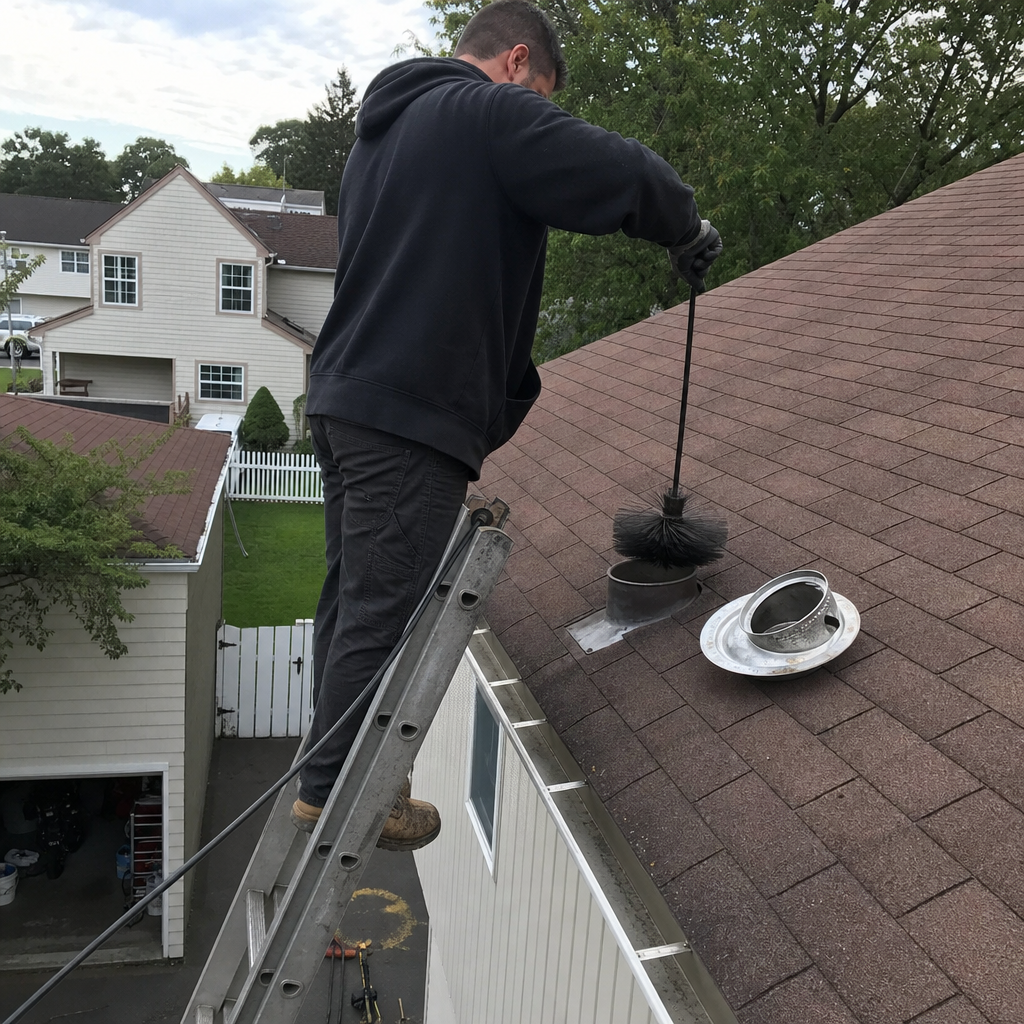
- Roof terminations in walk-up buildings: No resident regularly checks a roof cap four flights up. We’ve found caps completely sealed by lint and nesting material in Bushwick and Ridgewood properties.
- Gas dryer concentrations: New York’s gas infrastructure means more open-flame ignition sources near lint deposits than electric-dominant regions.
These factors don’t appear on generic warning-sign lists because they’re specific to dense, old urban housing. They’re exactly why Empire’s inspection protocol starts with measuring your actual vent run length and elbow count before we touch a cleaning tool.
What Empire’s Inspection Actually Finds
Our Dryer Vent Cleaning process begins with diagnostic work that generalist HVAC companies skip. Using Nikro vacuum systems, we establish negative pressure through the full vent run — not just the accessible sections near the dryer. This matters because:
Partial blockages show as reduced airflow at the cap with normal pressure at the machine. Full blockages show pressure buildup at both points. Without negative-pressure testing, you can’t distinguish them, and the cleaning approach differs. A partial blockage needs rotary brush agitation to dislodge wall-hugging lint. A full blockage may require sectional access or cap removal to avoid compacting the obstruction further.
Steven runs this inspection himself on every job. He checks the transition duct — the short flex line connecting dryer to wall — for crimps, improper material, or heat damage. He verifies the termination cap opens freely and seals when closed. He measures actual run length against code limits. These steps take ten extra minutes and have caught fire hazards that “blow-and-go” cleaners missed entirely.
Our Rotobrush and Nikro equipment isn’t marketing language — it’s the same rotary-brush and high-volume vacuum systems used by commercial and industrial contractors who can’t afford callbacks. Paired with Honeywell and Aprilaire air quality tools for the full indoor environment, we can address what enters your home, not just what leaves your dryer.
When “Normal” Dryer Behavior Isn’t
Some signs get dismissed because they develop gradually. Compare your dryer’s current performance against these benchmarks:
| What You’re Experiencing | What It Likely Means | Recommended Action |
|---|---|---|
| Heavy towels still damp after 60+ minutes | Restricted airflow, likely lint buildup | Schedule inspection within 1-2 weeks |
| Visible lint around interior wall or roof cap | Partial blockage with back-pressure | Schedule within 1 week |
| Burning smell at cycle start | Lint contacting heat source | Stop use, call same day |
| Flap barely opens during cycle | Severe blockage or cap damage | Stop use, call same day |
| Shared laundry room, no maintenance records | Unknown accumulation in common riser | Contact property manager, request inspection |
Clean ducts aren’t a luxury — they’re just what the air in your home deserves. Eleven years of one specialty and nearly 1,000 customer reviews at 4.9 stars tell us New Yorkers agree once they understand what’s actually in their vent runs.
FAQs
Most residential dryer vent cleanings in New York run between $150 and $350 depending on vent length, accessibility, and whether the run requires roof or cap work. Multi-floor buildings with interior-wall routing or shared risers may fall at the higher end. We provide upfront pricing after inspection — no surprises, no pressure. Call (877) 542-5983 for a free estimate.
Yes — we offer same-day service for burning smells, stuck flaps, or other urgent fire-risk signs. For routine maintenance, we typically schedule within 48 hours. Because Steven runs the job himself rather than dispatching untrained crews, our availability reflects actual technician capacity, not call-center promises.
DIY brush kits from hardware stores reach only the first few feet of most New York vent runs and can compact lint deeper into long, elbowed systems. For short, straight, accessible vents in single-family homes, light DIY maintenance between professional cleanings is reasonable. For NYC’s typical 20-40 foot runs with multiple elbows, professional equipment with negative-pressure extraction is necessary for actual clearance. We’ve been called to fix DIY compaction jobs that cost more to correct than the original professional cleaning would have.
Annual cleaning is the minimum for any dryer vent; every six months for heavy use or shared laundry facilities. In New York specifically, we recommend fall inspection before winter heavy-fabric loads, and immediate service if you notice any of the warning signs above. Co-op and condo associations should maintain shared risers on a documented schedule — individual residents can’t monitor what they don’t control.
When to Call Empire Air Duct Cleaning Service New York
If you’ve noticed longer dry times, lint at the cap, burning smells, or a flap that won’t open — or if you simply don’t know when your vent was last inspected — we’re straightforward to reach. Steven handles the assessment himself, explains what he finds before touching anything, and leaves the site cleaner than he found it. His daughter’s right that he talks about ductwork too much, but eleven years of focused work and 982 verified reviews suggest customers don’t mind the thoroughness.
Empire Air Duct Cleaning Service New York offers no-pressure dryer vent assessments across all five boroughs. Call (877) 542-5983 for a free estimate, or visit our homepage to learn more about our full indoor air quality services.
Written by Steven Ramirez, Owner & Lead Technician at Empire Air Duct Cleaning Service New York, serving New York, NY.