
Dryer Vent Cleaning Cost in New York: What You’ll Actually Pay Based on Your Building
Dryer vent cleaning in New York typically costs between $150 and $450, with most single-family and standard apartment jobs falling in the $180–$280 range. The exact price depends almost entirely on your vent routing—how long the run is, how many turns it takes, and whether it terminates through a wall or up to a rooftop. Call (877) 542-5983 for a free, no-surprise estimate based on your specific building.
New York’s housing stock creates vent configurations you won’t find in suburban markets. A dryer vent in a three-story Brooklyn brownstone can run 20–35 feet through interior walls before it ever sees outside air—triple the length of a typical suburban run, and triple the lint accumulation. Pre-war co-ops in the Upper West Side often route vents through masonry chases built in the 1920s. Queens walk-ups frequently terminate through roof caps three stories above the laundry room. These aren’t edge cases here—they’re the norm, and they directly determine what you’ll pay and how thoroughly the job needs to be done.
What Drives Dryer Vent Cleaning Cost in NYC Buildings
We’ve cleaned dryer vents in every borough, from Staten Island bungalows to Washington Heights high-rises. The price variation isn’t arbitrary. Here’s what actually moves the number:
- Vent run length: Every additional foot of ductwork adds lint surface area and access complexity. A 35-foot run through a Park Slope brownstone requires significantly more time and equipment reach than an 8-foot straight shot in a Fresh Meadows ranch.
- Number of elbows/turns: Each 90-degree turn reduces airflow efficiency and creates lint trap points. NYC’s tight construction often forces three or four elbows where building code would prefer two.
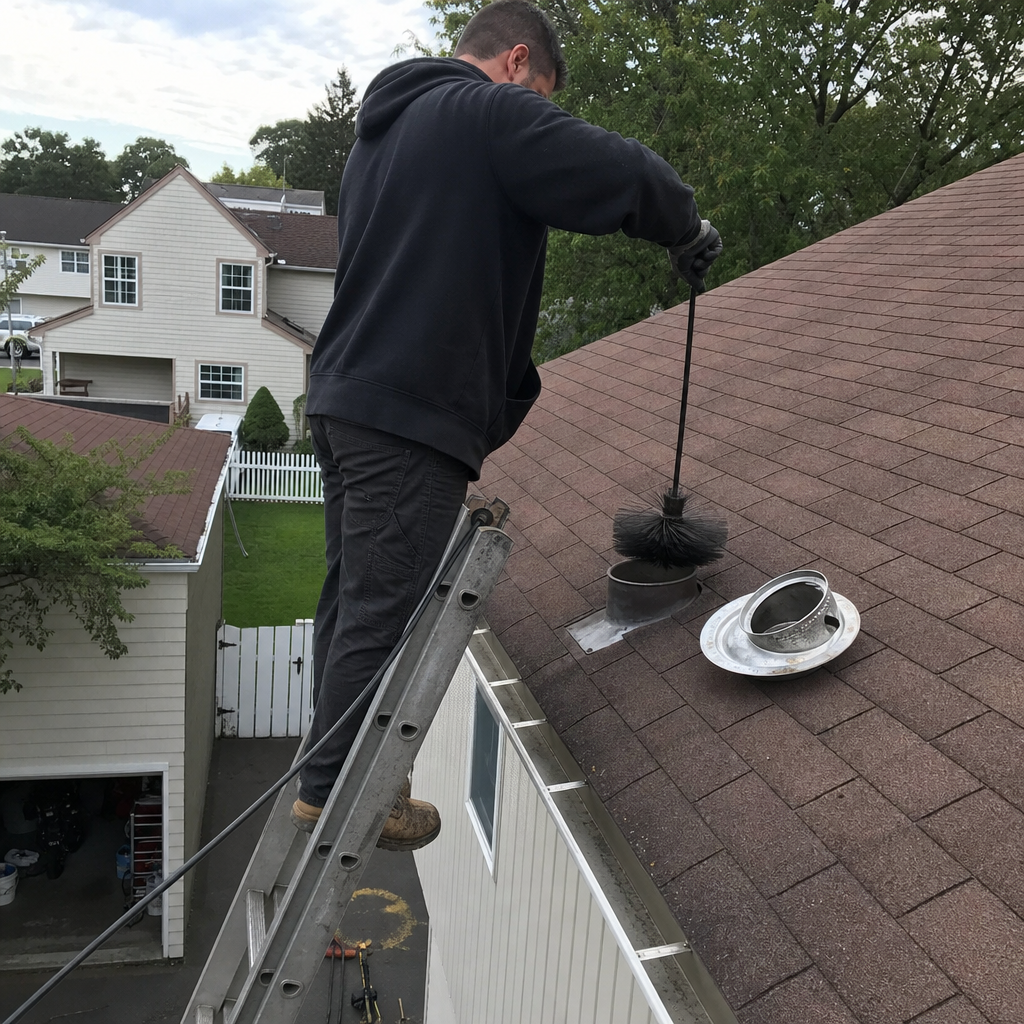
- Termination type: Wall caps at ground or second floor are straightforward. Rooftop terminations—common in multi-family buildings from Astoria to the South Bronx—require ladder or roof access, weather-seal inspection, and often coordination with building management.
- Access conditions: Finished basements with drywall ceilings, utility closets packed with storage, or appliances wedged into tight galley kitchens all add setup time.
- Multi-family coordination: Co-op and condo buildings frequently require superintendent notification, insurance certificate submission, and scheduled service windows—factors that don’t exist in single-family work.
Steven Ramirez, our owner and lead technician, grew up in Jackson Heights watching his uncle work HVAC jobs across the five boroughs. He learned early that New York buildings don’t follow textbook diagrams. That firsthand familiarity with the city’s housing stock—pre-war masonry, post-war brick, converted brownstones, new construction glass towers—is why we don’t quote blind. We ask about your building type, floor, and vent termination before we name a price.
NYC Dryer Vent Cleaning Cost Breakdown
These are the ranges we see in our actual New York work. Your job may fall at the low end or require the upper tier depending on the factors above.
| Service Type | Typical Cost Range |
|---|---|
| Standard residential: single elbow, wall termination, under 15 feet | $150 – $200 |
| Moderate complexity: 2–3 elbows, 15–25 foot run, standard access | $200 – $280 |
| Extended run: 25–40 feet, multiple elbows, interior wall routing | $280 – $350 |
| Rooftop termination or difficult access (finished ceilings, roof ladder required) | $320 – $450 |
| Multi-unit building: per-vent pricing with building coordination | $180 – $250 per unit |
| Transition duct replacement (flexible duct from dryer to wall) | $45 – $85 additional |
We use Nikro vacuum systems that create true negative pressure through the full vent run. For long NYC configurations, suction-only methods—the kind some generalist HVAC techs or plumbers bring as a side service—leave compressed lint in elbow corners and mid-run sags. Our rotary brush system dislodges buildup while the vacuum pulls it out, which matters enormously when you’re pushing 30 feet of tool through a Queens walk-up wall chase.
Why Vent Routing Makes NYC a Different Market
Most online pricing guides assume a suburban baseline: 8–12 foot run, one elbow, exterior wall termination. That describes maybe 15% of our New York calls.
In a typical Brooklyn brownstone conversion, the laundry area sits in the garden-level unit or basement. The vent runs up through two or three floors of framed wall, turns at a header, then exits through a rear wall or continues to a roof cap. We’ve measured 40-foot runs with four elbows in Crown Heights and Bed-Stuy properties. The lint doesn’t just accumulate—it stratifies, with dense packing at each turn and lighter, more flammable accumulation near the termination where airflow finally accelerates.
Manhattan pre-war buildings present their own puzzles. The Upper East Side and Upper West Side co-ops we serve often have original masonry chases that were never designed for modern dryers. The vent may share space with plumbing stacks or electrical conduit. Access requires removing panels in common hallways or working from adjacent units—always with building management coordination, sometimes with their preferred contractor observing.
Even newer construction complicates things. Glass curtain-wall buildings in Long Island City or downtown Brooklyn often route vents through mechanical shafts to centralized roof terminations. The runs are long, the access is restricted to maintenance windows, and the termination caps are exposed to wind-driven rain that accelerates corrosion and cap failure.
This is why we don’t match every low quote you’ll find. A $99 “dryer vent cleaning” in New York is almost always a suction-only pass with a shop vac, adequate for a 10-foot straight run and inadequate for what our buildings actually contain. We’ve been called in after those jobs to finish what they couldn’t reach.
NFPA 211, FDNY Statistics, and Why This Is Safety Spending
The National Fire Protection Association standard 211 specifies that dryer vents should be as short as possible, with limited elbows, and terminated to the exterior with proper backdraft prevention. New York’s building stock often predates or conflicts with this standard through no fault of current owners—you can’t reframe a 1920s co-op to accommodate a straighter vent run.
What you can do is maintain what you have correctly. The FDNY responds to hundreds of residential dryer fires annually, with lint ignition consistently among the leading causes. In dense multi-family housing, a dryer fire in one unit propagates through common walls and shafts with terrifying speed. The 2022 Bronx fire that killed 17 people started from a space heater malfunction, but it renewed city attention to all residential heating and ventilation fire risks—including dryer vents in buildings with limited egress options.
We document what we find. If your vent run violates NFPA 211 guidance in ways that increase fire risk—too many elbows, improper transition duct material, damaged or missing termination cap—we’ll show you photographically and explain your options. Sometimes a full re-routing isn’t feasible, but more frequent cleaning, a booster fan installation, or transition duct upgrade meaningfully reduces risk.
Our equipment includes Rotobrush rotary systems and Nikro high-velocity vacuums—the same tools specified for commercial and industrial duct maintenance. For air quality sanitizing after cleaning, we use solutions compatible with Honeywell and Aprilaire system standards. This isn’t overkill for residential work; it’s what’s required to actually clear long, complex NYC vent runs.
What Gets Missed When Dryer Vent Cleaning Is a Side Job
Generalist HVAC companies and plumbers often add “dryer vent cleaning” to their service menus without investing in proper equipment or training. We’ve seen the results: compressed lint pushed further into the run, damaged flexible transition ducts left in place, termination caps never inspected.
Steven runs every job himself. Here’s what that actually means on a dryer vent call:
- Full run inspection before touching anything: We feed a camera or inspect accessible sections to locate blockages, damage, and improper materials (plastic flex duct, PVC pipe, screws protruding into airflow).
- Transition duct examination: The 4–6 foot flexible duct from your dryer to the wall is where most immediate fire risk lives. We check for kinks, crushing, tears, and improper material. Foil flex is common but inferior to rigid or semi-rigid metal—we’ll tell you if replacement is warranted.
- Termination cap function: We verify the exterior cap opens under dryer airflow, closes when off (preventing pest entry and backdraft), and isn’t blocked by lint, paint, or physical damage. Rooftop caps get checked for weather seal integrity.
- Airflow verification: After cleaning, we measure airflow at the termination or use back-pressure gauges to confirm the vent performs within manufacturer specifications.
This level of inspection takes time. It’s why our jobs run longer than a quick vacuum pass—and why they actually solve the problem.
Multi-Family Buildings: Co-ops, Condos, and Rental Walk-Ups
If you manage or live in a multi-family building, dryer vent cleaning involves coordination that single-family homeowners don’t face. We’ve developed procedures for these common New York scenarios:
Co-op/condo with shared laundry room: The board or management company typically requires certificate of insurance, scheduled service windows, and sometimes escorted access. We handle this paperwork routinely and can coordinate with your superintendent.
Individual unit dryers with common vent shafts: Some pre-war buildings route multiple units into a common vertical shaft. Cleaning these requires accessing each unit’s connection and often the main shaft termination. We assess whether individual unit cleaning is sufficient or if full-shaft service is needed.
Rental buildings with tenant turnover: Property managers in neighborhoods like Harlem, Bushwick, and Ridgewood schedule annual or bi-annual vent cleaning as part of unit turnover or preventive maintenance. We offer per-unit pricing that scales for full-building service.
The coordination adds administrative time, which factors into pricing. But the alternative—deferred maintenance, lint accumulation, and elevated fire risk in buildings with dozens of families—carries far higher costs.
How Often Should New York Dryer Vents Be Cleaned?
For standard single-family use, the NFPA recommends annual inspection and cleaning as needed. In New York’s multi-family, high-use environment, we suggest more frequent attention:
- Single-family or 1–2 person household, standard run: every 12–18 months
- Family of 3–4, heavy laundry use: annually
- Extended run (20+ feet) or multiple elbows: annually regardless of use level
- Multi-family shared laundry: every 6–12 months depending on cycle volume
- Rental turnover units: with each tenant change, or annually minimum
Warning signs that immediate cleaning is needed: clothes taking longer than one cycle to dry, visible lint accumulation around the interior dryer vent connection, burning smell during operation, or the exterior termination cap not opening during dryer use.
FAQs
Most New York dryer vent cleanings cost between $180 and $280 for standard residential jobs, with complex or extended runs reaching $350–$450. The price depends on vent length, number of turns, termination type, and building access conditions. Call (877) 542-5983 for a free estimate based on your specific building.
DIY brush kits cost $20–$40 but rarely reach full lint accumulation in long NYC runs with multiple elbows, and they can’t create the negative pressure needed to extract dislodged debris. More critically, improper cleaning can compact lint into blockages or damage flexible transition ducts. For New York’s typical vent configurations, professional cleaning with rotary brush and vacuum systems is both more effective and safer. Call (877) 542-5983 to discuss what’s actually in your vent before deciding.
A straightforward wall-termination job takes 45–60 minutes. Extended runs through multiple floors, rooftop terminations, or multi-unit coordination typically require 90 minutes to 2.5 hours. We schedule realistic time windows and don’t rush the inspection and verification steps that confirm the job is complete.
Yes—lint accumulation is a leading cause of residential dryer fires, and professional removal of that fuel source directly reduces ignition risk. In New York’s dense housing, where fires propagate quickly through common walls and shafts, this maintenance is particularly critical. We also identify installation issues (improper materials, damaged caps, excessive elbows) that increase fire risk beyond lint accumulation alone. Call (877) 542-5983 to schedule inspection and cleaning.
What to Expect When You Hire Empire
We answer our own phone. Steven or our small office staff will ask about your building type, floor, dryer location, and any symptoms you’ve noticed. We’ll give you a realistic price range before scheduling, with no surprise add-ons at the door.
On service day, Steven arrives with Rotobrush and Nikro equipment, inspects before working, explains what he finds, and verifies results with airflow checks. We protect floors and work areas, and we leave the site cleaner than we found it. Our 982 verified reviews averaging 4.9 stars reflect eleven years of this approach—one job, one customer, one thoroughly cleaned vent at a time.
Clean ducts aren’t a luxury — they’re just what the air in your home deserves.
Ready to know exactly what your dryer vent cleaning will cost? Call (877) 542-5983 for a free estimate. We serve all five boroughs and schedule most jobs within 48 hours.
Written by Steven Ramirez, Owner & Lead Technician at Empire Air Duct Cleaning Service New York, serving New York, NY.